Cheese factories use closed-circuit cooling towers primarily for hygiene and safety, precise temperature control, and stable operation. Open-circuit towers cannot meet the food-grade sterility and temperature control requirements.
Industrial closed‑circuit cooling tower systems are ideal for applications requiring fluid purity, precise temperature control, and reduced water/chemical usage—especially in chemical, food, pharmaceutical, manufacturing, and data center industries.
The core functions of chillers in the cosmetics industry are precise temperature control, rapid cooling, and constant temperature preservation, covering four major stages: emulsification/reaction, extraction, filling, and equipment cooling. These directly determine product activity, stability, and production efficiency.
The core functions of chillers in detergent production are precise temperature control, ensuring reaction stability, cooling materials, protecting equipment, and stabilizing formulations. They cover the entire process from synthesis, ingredient mixing, homogenization to filling/molding, directly determining product stability and yield.
In soap factories, chillers are mainly used for four key processes: saponification temperature control, extrusion/roller mill cooling, mold low-temperature quick-freezing, and cutting to prevent sticking. These processes ensure stable production and maintain the appearance and hardness of the finished product.
The core functions of chillers in perfume production are precise temperature control, low-temperature freezing filtration, fragrance locking and anti-volatile properties, and ensuring batch stability, covering the entire temperature control process from aging and freezing filtration to bottling.
In ice cream production, the core functions of a chiller are to rapidly cool the ingredients, maintain a constant aging temperature, dissipate heat from the freezing machine/quick-freezing equipment, and stabilize the workshop and refrigerant temperatures. These functions directly determine the smoothness of the texture, output, and energy consumption.
After slaughter, poultry carcasses have high body temperature and rapid bacterial growth. Using a water chiller to produce low-temperature ice water quickly cools the carcass, locking in freshness and meeting food safety refrigeration standards, reducing weight loss and improving meat quality.
The chiller produces low-temperature chilled water, which is pumped to the indoor heat exchange terminal to remove heat from the facility. The water then flows back to the chiller for further cooling. This closed-loop water circulation maintains a constant temperature and humidity throughout the process, with no direct airflow.
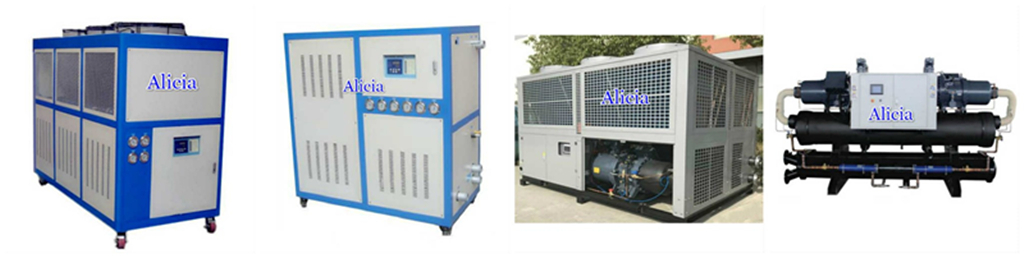
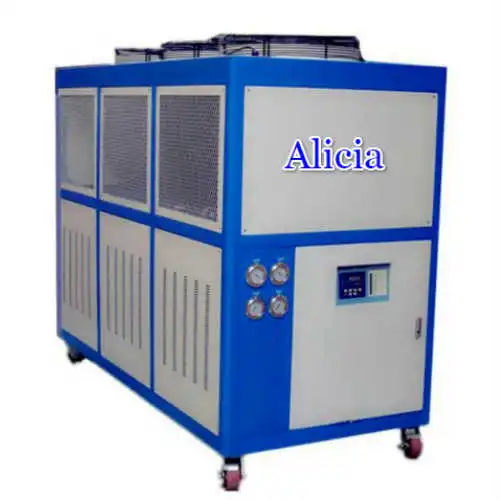
Air-cooled chillers are core cooling equipment in poultry farms, eliminating the need for cooling towers and water sources. They are used for incubation temperature control, chicken house cooling, and pre-cooling during slaughtering and processing, suitable for water-scarce/outdoor/small- to medium-sized scale farming scenarios.