What are the differences between closed cooling towers and open cooling towers?
There are differences between closed cooling towers and open cooling towers in terms of structure, working principle, performance characteristics, etc., and their respective advantages are also different, as follows:
Structure
Closed cooling tower: mainly composed of heat exchanger, spray system, fan, water collection tank, shell, etc. The heat exchanger usually adopts coil type or plate type. The cooled medium flows in the heat exchanger and exchanges heat with the external spray water and air.
Open cooling tower: It is composed of tower body, filler, spray system, fan, water collection tank and other parts. The tower body is generally an open structure, and air can enter and exit freely. The filler is its key component, which is used to increase the contact area and contact time between water and air.
Working Principle
Closed cooling tower: The cooling medium is sent into the heat exchanger through a circulating water pump, and the spray system sprays water evenly on the surface of the heat exchanger to form a water film. The fan runs to make the air flow through the surface of the heat exchanger, and the water film evaporates and absorbs heat, thereby taking away the heat of the cooled medium. At the same time, some hot water will flow back to the water collection tank for recycling.
Open cooling tower: Using the principle of water evaporation and heat dissipation, the spray system evenly sprinkles hot water on the filler to form water droplets and water film. Air enters from the bottom of the tower under the action of the fan and fully contacts the water on the filler. The water evaporates and absorbs heat, which reduces the water temperature. The cooled water is collected in the water collection tank for recycling.
Cooling effect
Closed cooling tower: The cooling effect is relatively stable and is less affected by environmental humidity. Since the cooled medium is not in direct contact with the outside air, the entry of impurities and dust is reduced, and the cleanliness of the medium can be better maintained. It is suitable for occasions with high requirements for cooling water quality.
Open cooling tower: The cooling effect is better and the water temperature can be reduced to close to the wet bulb temperature. However, it is greatly affected by environmental humidity and air quality. The cooling effect will be reduced in a high humidity environment, and impurities, dust and microorganisms are easily mixed into the cooling water.
Water quality maintenance
Closed cooling tower: The closed system is relatively closed, the water quality is not easily polluted by the outside world, and the maintenance cost is low. It is only necessary to regularly check and add a small amount of spray water, and sterilize and descale the system.
Open cooling tower: Since water is in direct contact with the outside air, it is easy to breed bacteria, algae and other microorganisms. Chemical agents such as bactericides and algaecides need to be added regularly. At the same time, the tower body needs to be cleaned regularly and part of the cooling water needs to be replaced to prevent scaling and corrosion. The water quality maintenance cost is high.
What are the respective advantages of closed cooling towers and open cooling towers?
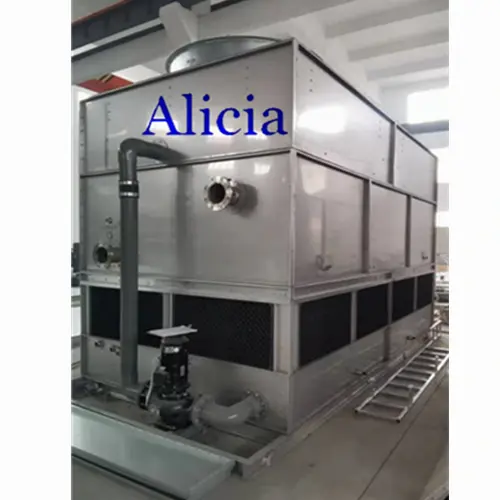
Protect the cooled medium: It can effectively prevent the cooled medium from being polluted and oxidized by the outside world. It is particularly suitable for cooling corrosive, easy to scale or expensive media, such as chemical raw materials, lubricating oil, hydraulic oil, etc.
Adapt to harsh environment: In dusty, windy or poor water quality environments, closed cooling towers can better ensure cooling effect and stable operation of the system, and reduce equipment failure and maintenance costs caused by impurities.
Reduce water waste: Spray water is circulated in the system, evaporation loss is relatively small, and it is not easily polluted by the outside world. Therefore, the consumption and replenishment of water resources are small, which meets the requirements of energy conservation and environmental protection.
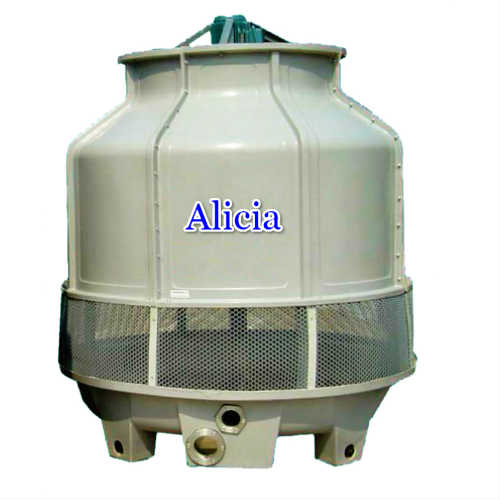
High cooling efficiency: It has a large heat dissipation area and good heat exchange effect, and can quickly cool hot water to a lower temperature. It is suitable for occasions with high cooling speed requirements, such as large industrial cooling systems, central air conditioning systems, etc.
Simple structure and low cost: The structure is relatively simple, and the equipment investment and maintenance costs are low. Its open structure is easy to inspect and maintain, parts are easy to replace, and no complex sealing devices and circulation systems are required.
Flexible operation: According to actual cooling needs, parameters such as fan speed and spray water volume can be flexibly adjusted to adapt to different working conditions and load changes. At the same time, the installation and commissioning of open cooling towers are relatively simple and can be put into use quickly.




 Dfferences in the production processes of champagne, wine, and rum


