Working principle: The cooling medium of the closed circuit cooling tower circulates in a closed pipe, and transfers heat to the spray water outside the pipe through the heat exchanger. The spray water flows along the surface of the heat exchanger under the action of gravity to form a water film. Part of the water in the water film evaporates and absorbs heat, which reduces the surface temperature of the heat exchanger, thereby achieving cooling of the cooling medium. At the same time, the fan introduces external air into the cooling tower to accelerate the evaporation of water and the dissipation of heat, thereby improving the cooling effect.
Structural composition
Closed circulation system: It consists of cooling pipes, circulating pumps, expansion tanks, etc. The cooling medium circulates in the cooling pipes, and the circulating pump provides power to make the cooling medium flow in the system. The expansion tank is used to compensate for the volume change of the cooling medium caused by temperature changes.
Heat exchanger: It is the core component of the closed cooling tower. High-efficiency heat transfer pipes, such as copper pipes or stainless steel pipes, are usually used to improve heat exchange efficiency. There are many structural forms of heat exchangers, such as tube type, plate type, etc., and their function is to transfer the heat in the cooling medium to the spray water.
Spray system: including spray pump, spray pipe and nozzle, etc. The spray pump transports the water in the water collection tank to the spray pipe, and sprays the water evenly on the surface of the heat exchanger through the nozzle to form a water film to achieve heat exchange between the cooling medium and the water.
Ventilation system: composed of fans, air ducts, etc. The fan introduces external air into the cooling tower, so that the air flows in the tower, accelerates the evaporation of water and the dissipation of heat. The function of the air duct is to guide the air flow and improve the ventilation efficiency.
Water collection tank: used to collect spray water and condensed water to provide water for the spray system. A water level control system is usually set in the water collection tank to ensure the stability of the water level.
Performance characteristics: In addition to the advantages mentioned above, such as good water quality protection, stable cooling medium, precise temperature control, strong corrosion resistance, adaptability to harsh environments and significant water-saving effects, the closed circuit cooling tower also has the characteristics of low operating noise. Because it uses advanced fan and noise reduction technology, the noise generated during operation is relatively small and has little impact on the surrounding environment.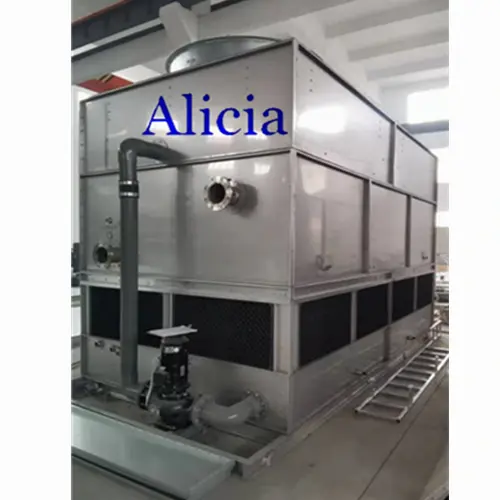
Closed cooling towers can provide efficient cooling for equipment or processes in a variety of scenarios. The following are some common application scenarios:
Power industry
Generator cooling: Whether it is thermal power generation, hydropower generation or nuclear power generation, the generator set will generate a lot of heat during operation. Closed cooling towers can cool the lubricating oil, hydraulic oil, and generator stator, rotor and other components of the generator set to ensure that the unit operates at a suitable temperature, improve power generation efficiency and equipment reliability, and extend the service life of the equipment.
Substation cooling: Electrical equipment such as transformers and switch cabinets in substations will generate heat during operation and need to be effectively cooled. Closed cooling towers can provide circulating cooling water for the cooling system of the substation to ensure the normal operation of electrical equipment and prevent equipment failure or power outages caused by overheating.
Chemical industry
Reactor cooling: Reactors in chemical production often release a lot of heat during chemical reactions, and need to be cooled in time to control the reaction temperature and ensure the stability and safety of the reaction. Closed cooling towers can provide a stable cooling medium for the cooling system of the reactor, accurately control the reaction temperature, and prevent the reaction from being out of control or the quality of the product from being degraded due to excessive temperature.
Chemical process cooling: In some chemical process, such as distillation, extraction, crystallization, etc., the process fluid needs to be cooled. Closed cooling towers can provide cooling services for these processes, ensure the smooth progress of the process, and improve the yield and quality of the product.
Mechanical processing industry
Metal cutting processing cooling: In the metal cutting process, the tool and the workpiece will generate a lot of heat due to friction, which affects the processing accuracy and tool life. Closed cooling towers can provide cooling for cutting fluid, keep the cutting fluid at a low temperature, effectively reduce the temperature of the tool and workpiece, improve the processing accuracy and surface quality, and extend the tool life.
Forging and heat treatment cooling: In the forging and heat treatment process, the workpiece needs to be cooled quickly after heating to obtain the required performance. Closed cooling towers can provide cooling medium to cool the workpiece during heat treatment processes such as quenching and tempering to ensure the quality and performance of the workpiece.
HVAC industry
Central air conditioning system cooling: In the central air conditioning system of large commercial buildings, office buildings, hotels and other places, closed cooling towers are used as cooling equipment to provide cooling water for chillers. By cooling the circulating water, the condensing temperature of the chiller is reduced, and the refrigeration efficiency is improved, thereby providing a comfortable air-conditioned environment for the room and reducing energy consumption.
Industrial air conditioning cooling: Some industrial production workshops have strict requirements on ambient temperature and humidity, and need to use industrial air conditioning systems. Closed cooling towers can provide support for the cooling system of industrial air conditioners, ensure the stable operation of the air conditioning system, and provide a suitable production environment for the workshop.
Electronics industry
Data center cooling: The servers, storage devices, etc. in the data center will generate a lot of heat during operation, and need to be cooled in time to ensure the normal operation of the equipment and the security of the data. The closed circuit cooling tower can be combined with the cooling system of the data center. By cooling the circulating water, it can provide cooling for the air conditioning system of the data center or directly for equipment such as servers, thereby reducing the energy consumption and operating costs of the data center.
Electronic equipment manufacturing cooling: In the process of electronic equipment manufacturing, such as semiconductor chip manufacturing, circuit board production, etc., the control requirements for process temperature are very strict. The closed circuit cooling tower can provide precise cooling for various equipment and processes in the manufacturing process to ensure product quality and production efficiency.
The core selling points of closed cooling towers include the following:
High efficiency and energy saving: Closed cooling towers utilize a closed circulation system, minimizing water loss due to evaporation. Compared to open systems, this can reduce evaporation by over 80%, resulting in lower water makeup and energy consumption. Furthermore, they are typically equipped with variable-frequency fans and pumps, which automatically adjust operating frequency based on actual cooling needs. Overall energy consumption is 30%-50% lower than traditional open cooling systems. Furthermore, some models can integrate waste heat recovery systems to further enhance energy efficiency.
Water quality protection: Cooling water circulates within a closed system, preventing contact with outside air, dust, and impurities. This reduces the risk of water contamination and lowers dissolved oxygen content, making water quality easier to control and reducing the potential for scaling and corrosion. This effectively protects cooling equipment and is particularly suitable for applications requiring high water quality.
High system stability: Cooling water is kept away from direct contact with the outside air, preventing the impact of environmental changes such as wind, sand, rain, and pollutants on the cooling system. Closed-circuit cooling towers can more precisely control cooling water temperature, ensuring the equipment always remains within the optimal operating temperature range. They are often equipped with antifreeze protection, enabling operation in low-temperature environments, reducing the risk of leakage and improving system stability and safety.
Low Maintenance Costs: The closed-circuit system reduces the ingress of impurities and contaminants, lowering the risk of equipment clogging and corrosion, thereby reducing maintenance frequency. Furthermore, many closed-circuit cooling towers feature a modular design for easy installation, disassembly, and maintenance. They are also equipped with intelligent monitoring systems that monitor operating status in real time, enabling prompt identification and resolution of problems, reducing maintenance costs.
Environmentally Adaptable: The closed structure of closed-circuit cooling towers enables efficient operation in areas with strong winds and poor air quality. By adding antifreeze, they can operate at temperatures as low as -30°C, making them suitable for highly corrosive environments such as chemical industrial parks and coastal areas. Furthermore, most models operate with a noise level below 65 decibels, meeting urban environmental standards. High space utilization: Closed cooling towers usually adopt a compact design and occupy a small area. Compared with open towers with the same cooling capacity, they can save more than 30% of space and do not require the excavation of a water tank. Their modular design can also be flexibly combined according to needs to adapt to different capacity requirements. The installation location is flexible and can be installed on the roof, on the ground or even indoors.
About Us
Alicia Import and Export Trade Co., Ltd. is a professional company based in Changsha, Hunan, China. We specialize in the import and export of plastic auxiliary machines, providing customers with high-quality equipment for plastic processing. With extensive industry knowledge and a wide network of trusted suppliers, we are committed to delivering the best sourcing solutions for customers worldwide. Our services range from factory audits to comprehensive project management, ensuring a seamless process from procurement to delivery.
Why Choose Us?
- Wide Range of Products: We offer a variety of high-quality plastic auxiliary machines including shredders, crushers, mixers, and chillers.
- Extensive Network: With over 100 qualified factories, we source only from trusted manufacturers.
- Expertise: Over 10 years of experience in the plastic machinery industry.
- One-Stop Service: We provide comprehensive services, including factory audits, quality inspections, and logistics coordination.
- Dedicated Customer Support: We are committed to providing efficient and responsive customer service throughout the entire process.
FAQ
1. Who are we?
We are Alicia Import and Export Trade Co., Ltd., based in Changsha, China. We specialize in sourcing and supplying plastic auxiliary machines, offering services such as factory audits, quality control, and project management to ensure the best procurement experience for our clients.
2. How can we guarantee quality?
- Rigorous Supplier Selection: We only work with over 100 verified and trusted factories.
- Comprehensive Quality Control: Every product undergoes strict quality inspections to meet international standards.
- Factory Audits: We conduct regular factory audits to ensure compliance with quality and production standards.
- Continuous Monitoring: Our team oversees the entire production process, from the initial stages to final delivery.
- Post-Delivery Support: We offer after-sales support and product warranties to ensure your satisfaction.
3.What can you buy from us?
- Quality Assurance: We work exclusively with reliable and certified factories.
- One-Stop Sourcing: We provide complete sourcing services, including quality checks and project management.
- Industry Expertise: Over a decade of experience in the field of plastic machinery.
- Competitive Pricing: Our strong network allows us to offer cost-effective solutions.
- Global Service: We ensure seamless delivery and offer responsive customer support throughout the entire process.
4. Why should you buy from us instead of other suppliers?
- Quality Assurance: We work exclusively with reliable and certified factories.
- One-Stop Sourcing: We provide complete sourcing services, including quality checks and project management.
- Industry Expertise: Over a decade of experience in the field of plastic machinery.
- Competitive Pricing: Our strong network allows us to offer cost-effective solutions.
- Global Service: We ensure seamless delivery and offer responsive customer support throughout the entire process.
5. What services can we provide?
- Sourcing: We help you find the best plastic auxiliary machines from reliable suppliers.
- Factory Audits: We perform detailed audits to ensure your chosen factories meet required standards.
- Quality Control: We carry out inspections and tests to guarantee product quality before shipment.
- Project Management: From the initial order to final delivery, we manage all aspects of your project.
- Logistics Coordination: We assist with shipping, customs clearance, and consolidation of goods.
- After-Sales Support: Our team is available to assist you post-purchase with any issues or inquiries.


