Industrial Closed‑Circuit Cooling Tower Systems for Process Cooling Applications
1. Working Principle (Dual‑Circuit Design)
Primary Circuit (Closed Process Loop)
Process fluid flows inside a coil (heat exchanger, copper/steel/stainless steel).
No direct contact with ambient air → no contamination, scaling, or evaporation loss of process fluid.
Hot process fluid enters the coil, transfers heat to the coil wall, and exits cooled back to the process.
Secondary Circuit (Open Evaporative Loop)
Spray water is distributed over the outside of the coil.
Fans force/draw air across the coil; partial evaporation of spray water absorbs heat from the coil, cooling the internal process fluid.
Spray water collects in a basin, recirculates, with minimal blowdown to control concentration cycles.
Heat Flow
Process fluid → coil wall → spray water + air → atmosphere.
2. Core Components
Coil (Heat Exchanger): Finned/tubed (galvanized steel, copper, stainless steel) for high heat transfer.
Fan System: Induced‑draft (fan on top) or forced‑draft (fan at bottom); axial/centrifugal, often VFD‑controlled.
Water Distribution: Spray nozzles, drift eliminators (reduce water carryover), and a collection basin.
Piping & Controls: Closed‑loop pumps, valves, temperature sensors, and PLCs for precise setpoint control.
3. Advantages of Industrial Closed-Circuit Cooling Towers
No fluid contamination
Process liquid runs inside sealed coils, isolated from air and outdoor dirt. Ideal for pure, sterile or corrosive fluids.
Less water consumption
Only external spray water evaporates; far lower water loss than open cooling towers.
Lower chemical usage
Minimal scaling, algae and bacteria growth, so fewer water treatment chemicals are needed.
Stable cooling performance
Consistent temperature output, suitable for precision production processes.
Reduced maintenance
Internal pipes hardly foul or scale, cutting cleaning, descaling and downtime costs.
Freeze protection & wide adaptability
Works safely in cold areas; can add glycol to the closed loop, and run dry cooling mode in winter.
Wide fluid compatibility
Supports water, glycol, oil, brine and other special cooling media directly.
Long service life for process equipment
No corrosion or fouling inside production equipment, extending its lifespan.
4. Common Applications of Industrial Closed-Circuit Cooling Towers
Plastics & Molding Industry
Cool injection molds, blow molding machines, die-casting equipment and hydraulic systems; ensures stable product quality.
Chemical & Petrochemical Industry
Cool reaction kettles, distillation condensers, heat exchangers and process pipelines; suits corrosive & high-purity process fluids.
Food & Beverage Processing
Cool fermentation tanks, pasteurization units, beverage production lines and food-grade fluid loops; meets hygiene requirements.
Pharmaceutical & Biotech
Cool bioreactors, chromatography systems and sterile production equipment; prevents fluid contamination strictly.
Machinery & Metalworking
Cool CNC machine spindles, welding equipment, induction heating devices and cutting fluid systems.
Power & Electrical Industry
Cool transformers, generator sets, high-voltage cabinets and gas turbine auxiliary systems.
New Energy & Electronics
Battery production lines, EV battery thermal management, data center server cooling and laser equipment.
General Industrial Scenarios
Central factory process cooling, air compressor cooling, refrigeration unit condenser cooling, and systems requiring freeze protection with glycol solution.
5. Selection Considerations
Heat Load: Calculate total heat rejection (kW) and design ΔT.
Fluid Type: Water, glycol (30–50% for freeze protection), oil, or specialty fluids.
Ambient Conditions: Dry/wet bulb temperatures, altitude, and humidity (affects capacity).
Material Compatibility: Coil material (copper for water, stainless steel for corrosive fluids).
Fan Control: VFD fans for energy savings at part load.
Winterization: Glycol in process loop or dry‑mode operation to prevent freezing.
6. Comparison with Open‑Loop Cooling Towers
| Feature |
Closed‑Circuit CoolingTower |
Open‑Loop Cooling Tower |
| Process Fluid Contact |
Isolated (closed coil) |
Direct with air |
| Fluid Purity |
High (no contamination) |
Low (dust, bacteria, scale) |
| Water Loss |
Minimal (only spray evaporation) |
High (process + spray evaporation) |
| Chemical Treatment |
Minimal |
Extensive (biocides, scale inhibitors) |
| Maintenance |
Low |
High (coil cleaning, descaling) |
| Cost |
Higher initial, lower O&M |
Lower initial, higher O&M |
7. Summary
Industrial closed‑circuit cooling tower systems deliver reliable, efficient, and low‑maintenance process cooling by isolating process fluids in a closed loop while rejecting heat via evaporative cooling. They are ideal for applications requiring fluid purity, precise temperature control, and reduced water/chemical usage—especially in chemical, food, pharmaceutical, manufacturing, and data center industries. 


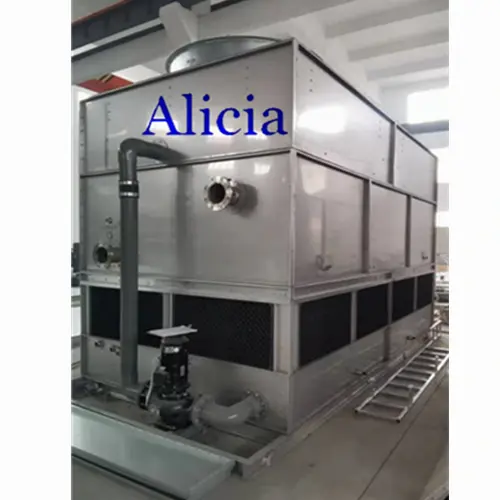 Why are closed-circuit cooling towers needed to make cheese?
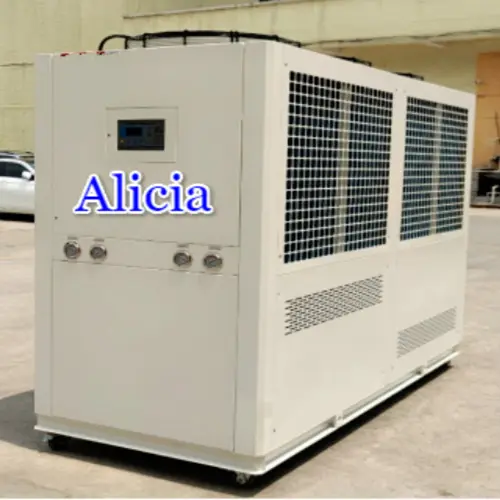 How are chillers used in the cosmetics manufacturing industry?
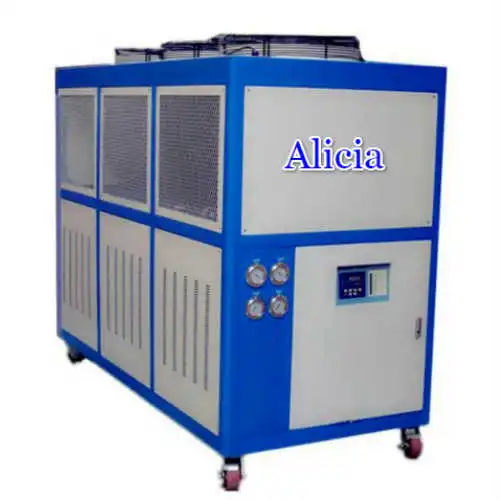 How are water chillers used in the detergent manufacturing industry?
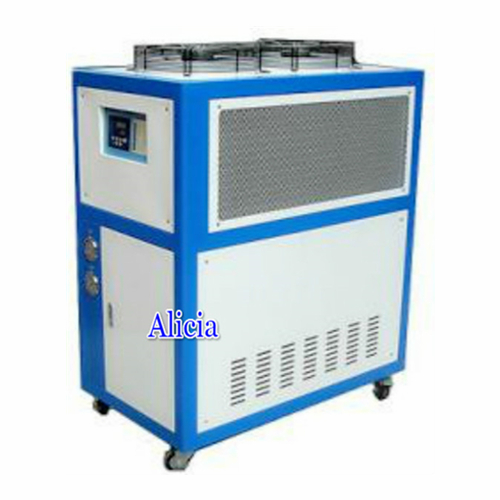 How are water chillers used in the soap manufacturing industry?
