We use cookies to improve your online experience. By continuing browsing this website, we assume you agree our use of cookies.

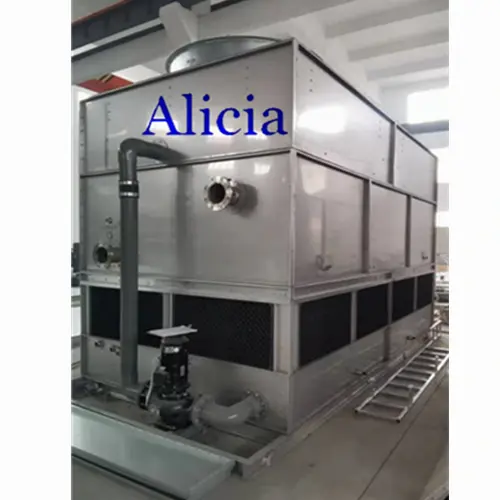
Industrial closed circuit water cooling towers for sale

Count flow Closed Circuit Cooling Tower
Model ASCT-50
Water flow m3/h 50
Water in temperature ℃ 37
Water out temperature ℃ 32
Wet ball temperature ℃ 28
Quantity set 1
Cooling capacity kcal/h 250000
Machine size (lenght*width*height) mm 2350×1500×
Description
Description
Industrial closed circuit water cooling towers for sale

A closed circuit cooling tower is a cooling device that combines water-cooling with air-cooling. The following is a detailed introduction to its principles, structure, applications, etc.
structure diagram for closed cooling tower

Working principle: The cooling medium of the closed circuit cooling tower circulates in a closed pipe, and transfers heat to the spray water outside the pipe through the heat exchanger. The spray water flows along the surface of the heat exchanger under the action of gravity to form a water film. Part of the water in the water film evaporates and absorbs heat, which reduces the surface temperature of the heat exchanger, thereby achieving cooling of the cooling medium. At the same time, the fan introduces external air into the cooling tower to accelerate the evaporation of water and the dissipation of heat, thereby improving the cooling effect.
Structural composition

Closed circulation system: It consists of cooling pipes, circulating pumps, expansion tanks, etc. The cooling medium circulates in the cooling pipes, and the circulating pump provides power to make the cooling medium flow in the system. The expansion tank is used to compensate for the volume change of the cooling medium caused by temperature changes.

Heat exchanger: It is the core component of the closed circuit cooling tower. High-efficiency heat transfer pipes, such as copper pipes or stainless steel pipes, are usually used to improve heat exchange efficiency. There are many structural forms of heat exchangers, such as tube type, plate type, etc., and their function is to transfer the heat in the cooling medium to the spray water.

Spray system: including spray pump, spray pipe and nozzle, etc. The spray pump transports the water in the water collection tank to the spray pipe, and sprays the water evenly on the surface of the heat exchanger through the nozzle to form a water film to achieve heat exchange between the cooling medium and the water.
Ventilation system: composed of fans, air ducts, etc. The fan introduces external air into the cooling tower, so that the air flows in the tower, accelerates the evaporation of water and the dissipation of heat. The function of the air duct is to guide the air flow and improve the ventilation efficiency.

Water collection tank: used to collect spray water and condensed water to provide water for the spray system. A water level control system is usually set in the water collection tank to ensure the stability of the water level.

Performance characteristics: In addition to the advantages mentioned above, such as good water quality protection, stable cooling medium, precise temperature control, strong corrosion resistance, adaptability to harsh environments and significant water-saving effects, the closed circuit cooling tower also has the characteristics of low operating noise. Because it uses advanced fan and noise reduction technology, the noise generated during operation is relatively small and has little impact on the surrounding environment.
counter flow closed cooling towers

closed circuit cooling towers are widely used in industries with strict water quality, temperature control, and environmental requirements. The following are their primary applications:

Power Industry: They are used in the cooling systems of thermal power plants, nuclear power plants, and gas turbine generator sets. They can also cool transformers and power electronics such as inverters and rectifiers. They can also be used to cool steam condensers, improving condensation efficiency.

Chemical Industry: They can be used to cool various chemical media, such as reactors, compressors, and process media in synthesis towers. They are also widely used in oil refineries, cracking equipment, and lubricant production, eliminating the contamination risks associated with open cooling towers.

Metallurgical Industry: Circulating water cooling for equipment such as blast furnaces, continuous casting machines, and rolling mills requires closed circuit cooling towers to ensure proper operation, improve production efficiency, and enhance product quality.

Electronics Industry: In semiconductor wafer manufacturing, precision equipment such as lithography machines and ion implanters requires extremely precise cooling water temperature. closed circuit cooling towers can minimize temperature fluctuations and, combined with deionized water filtration, significantly improve chip production yields. It can also be used to dissipate heat in liquid cooling systems for data center servers.
Food and Pharmaceutical Industries: Pharmaceutical reactors and food processing lines have stringent requirements for cooling medium cleanliness and temperature accuracy. closed circuit cooling towers utilize pure water circulation or ethylene glycol solution for indirect cooling, preventing microbial contamination and medium deterioration, while meeting GMP standards and food safety regulations.
New Energy Industry: Wind turbine gearboxes and generator lubricating oil require continuous cooling. closed circuit cooling towers can provide stable cooling in remote locations, such as offshore wind farms. In solar power generation, circulating coolant can lower panel temperatures, improving power generation efficiency and extending component life. They can also be used to dissipate heat in electric vehicle batteries and new energy storage systems.
HVAC Industry: In large commercial buildings such as shopping malls, office buildings, and hotels, as well as industrial plants with strict indoor environmental requirements, closed circuit cooling towers serve as cooling equipment for air conditioning systems, cooling the condensers of air conditioner units, improving cooling efficiency and reducing energy consumption. Mechanical processing industry: In metal cutting, forging, heat treatment and other processes, closed circuit cooling towers can be used to cool cutting fluids, quenching oils, etc., to ensure processing accuracy and normal operation of equipment. For example, in the machining of automobile engine cylinders, the cutting fluid needs to be cooled to prevent overheating and wear of the tool.


The main selling points of closed circuit cooling towers include the following:
High efficiency and energy saving: Their closed-circulation system prevents the cooling water from coming into direct contact with the outside air, reducing evaporation losses and heat loss due to evaporation, thereby improving heat exchange efficiency. Furthermore, they are typically equipped with variable-frequency fans and pumps, which automatically adjust operating frequency based on actual cooling needs, further reducing energy consumption. Their energy consumption is 10%-30% lower than that of traditional open cooling towers.

Excellent water quality management: Cooling water circulates within a closed system, avoiding contact with outside air, dust, and impurities. This reduces the risk of water contamination and corrosion of pipes and equipment. Furthermore, water quality is easier to control, minimizing the risk of scaling and extending the service life of the cooling tower, heat exchanger, and pipes.

High system stability: Cooling water is kept out of direct contact with the outside air, preventing the impact of environmental fluctuations on the cooling system. This allows for more precise temperature control, ensuring that equipment remains within the operating temperature range. Furthermore, closed circuit cooling towers are often equipped with anti-freeze protection, enabling normal operation in low-temperature environments, reducing the risk of leakage and improving system stability and safety.

Environmentally Friendly: Evaporation losses in closed circuit cooling towers are far lower than those in open cooling towers, significantly reducing water consumption. They also require fewer chemical treatment agents, minimizing environmental pollution. Furthermore, they typically feature a low-noise design, producing quieter operating noise than open cooling towers, reducing noise pollution to the surrounding environment.
Low Maintenance Costs: Because the cooling water circulates within a closed system, the ingress of impurities and contaminants is minimized, reducing the risk of equipment clogging and corrosion, and thus reducing maintenance frequency. Many closed circuit cooling towers feature a modular design for easy installation, disassembly, and maintenance. They are also equipped with intelligent monitoring systems that monitor operating status in real time, enabling timely identification and resolution of problems and reducing maintenance costs.
Adaptability: They can be customized to meet specific needs, combining dry, wet, or hybrid cooling modes to adapt to varying ambient temperatures and cooling requirements. They can also be used in conjunction with a variety of equipment, including chillers, heat exchangers, and heat pumps, to meet diverse cooling needs.
Small Footprint: closed circuit cooling tower components are compactly installed, eliminating the need for a dedicated water tank. Compared to other cooling systems, these compact designs can reduce footprint and are particularly suitable for locations with limited space. High Cooling Efficiency: Utilizing a dual cooling method of air cooling and water spray evaporation for heat absorption, the system achieves high cooling efficiency. For example, in some applications, the temperature difference can be controlled within ±1°C, enabling rapid heat dissipation and ensuring efficient equipment operation.

About us

Welcome to Alicia lmport and Export Trade Co.. ltd!

Alicia lmport and Export Trade Co., Ltd..Your Plastic auxiliary machines sourcing Office in China

Aicia mport and Export Trade co Ld is a reliable and trustwothy sourcing agentin china,we located in changsha city,Hunan rovince in china. We focus on plasticauxlary machines . and we can ONE-sToP plastic auxlary machines sourcing services from sourcing,factory audit,aclinspection,proiect management products andsuppliers database,consolidation& transportation.etc.


We have been doing this business for many vears, we have more than qou aualtied factorles network which coverednmeplastic auxiliary machines which arewidely used in injection molding, extrusion, blow molding industries.

Main plastic auxiliary machines sold: Plasticshredide, Plastic Crusher, hasticmiker miachine, volumatnic colormiker, &rawimaticbatch iender, plastichoperdyer,pastc altoloade,water cher ,colngtower, moldtemperatlre controler, conveyor machine,Washing tank, plastic dehdrstormachine, extrusion granulaion ines, lasic pelet ute machine, wbeathesarean storage tank. and so onthe aim of Alcla companny is to do the wn-wn business, to help more and more orelan buvers ind the plastc auxliar machines trom chna quicky and eficienv.Main Trade Markets: Asia.North America.South America.and Africa.oceania.

Our successis dependent upon and measured by the achievements of our customers.

Choose us,we could be your arms connecting China. Do not hesitate to contact us!


FAQ

Manufacturer or Trading Company? Where is the company located?

Alicia Import and Export Trade Co., Ltd is your sourcing office in Changsha City, Hunan Province in China. We provide one-stop plastic auxiliary machines sourcing services.


What is the turnover of your company for plastic auxiliary machines?

Last year’s annual sales were 3-5 million yuan, and it will increase year by year in the future.


What plastic auxiliary machines can the company supply?

Plastic shredder machines

Plastic crusher machines

Crusher blade sharpeners

Plastic mixer machines

Industrial water chillers

Cooling towers

Dehumidifiers and dryers machines

Plastic auto loaders

Volumetric color mixers

Gravimetric batch blenders

Mold temperature controllers

Conveyor belt machines

Plastic dehydrator machines

Extrusion granulation machines

Plastic pellet cutter machines

Vibrating screens

Storage tanks, and more.

Where are the main markets of plastic auxiliary machines?

Main Trade Markets:

Asia, Oceania, North America, South America, and Africa.


What advantages does Alicia Company have compared with its competitors?

Rich experience and industry knowledge

Competitive prices

Reliable quality

High efficiency

Fast delivery

Quick feedback

Comprehensive technical support


Can we offer quotations for plastic auxiliary machines not shown on the website?

Yes, you can. There are too many products in the plastic auxiliary machines category, and not all of them are displayed on the website.


Does the plastic auxiliary machine itself support OEM customization?

Yes, we support OEM customization for all plastic auxiliary machines.


What’s the minimum order quantity for plastic auxiliary machines?

Even if you only reserve one machine, you can still take advantage of the discount! You can also get the best discounts by ordering a larger quantity in one purchase.

Send your message to us
please select your country
  • Afghanistan
  • Aland Islands
  • Albania
  • Algeria
  • American Samoa
  • Andorra
  • Angola
  • Anguilla
  • Antigua and Barbuda
  • Argentina
  • Armenia
  • Aruba
  • Australia
  • Austria
  • Azerbaijan
  • Bahamas
  • Bahrain
  • Bangladesh
  • Barbados
  • Belarus
  • Belgium
  • Belize
  • Benin
  • Bermuda
  • Bhutan
  • Bolivia
  • Bosnia and Herzegovina
  • Botswana
  • Bouvet Island
  • Brazil
  • British Indian Ocean Territory
  • British Virgin Islands
  • Brunei Darussalam
  • Bulgaria
  • Burkina Faso
  • Burundi
  • Cambodia
  • Cameroon
  • Canada
  • Cape Verde
  • Caribbean Netherlands
  • Cayman Islands
  • Central African Republic
  • Chad
  • Chile
  • Christmas Island
  • Cocos Islands
  • Colombia
  • Comoros
  • Congo
  • Cook Islands
  • Costa Rica
  • Cote D'ivoire
  • Cuba
  • Curaçao
  • Cyprus
  • Czech Republic
  • Democratic Republic of the Congo
  • Denmark
  • Djibouti
  • Dominica
  • Ecuador
  • Egypt
  • El Salvador
  • Equatorial Guinea
  • Eritrea
  • Estonia
  • Ethiopia
  • Falkland Islands
  • Faroe Islands
  • Fiji
  • Finland
  • France
  • French Guiana
  • French Polynesia
  • French Southern Territories
  • Gabon
  • Gambia
  • Georgia
  • Germany
  • Ghana
  • Gibraltar
  • Greece
  • Greenland
  • Grenada
  • Guadeloupe
  • Guam
  • Guatemala
  • Guernsey
  • Guinea
  • Guinea-Bissau
  • Guyana
  • Haiti
  • Heard Island and Mcdonald Islands
  • Honduras
  • Hong Kong, China
  • Hungary
  • Iceland
  • India
  • Indonesia
  • Iran
  • Iraq
  • Ireland
  • Isle of Man
  • Israel
  • Italy
  • Jamaica
  • Japan
  • Jordan
  • Kazakhstan
  • Kenya
  • Kiribati
  • Korea
  • Kosovo
  • Kuwait
  • Kyrgyzstan
  • Laos
  • Latvia
  • Lebanon
  • Lesotho
  • Liberia
  • Liechtenstein
  • Lithuania
  • Luxembourg
  • Macedonia
  • Madagascar
  • Malawi
  • Malaysia
  • Maldives
  • Mali
  • Malta
  • Marshall Islands
  • Martinique
  • Mauritania
  • Mauritius
  • Mayotte
  • Mexico
  • Micronesia
  • Moldova
  • Monaco
  • Montenegro
  • Montserrat
  • Morocco
  • Mozambique
  • Myanmar
  • Namibia
  • Nauru
  • Nepal
  • Netherlands
  • Netherlands Antilles
  • New Caledonia
  • New Zealand
  • Nicaragua
  • Niger
  • Nigeria
  • Niue
  • Norfolk Island
  • Northern Mariana Islands
  • Norway
  • Oman
  • Pakistan
  • Palau
  • Palestine
  • Panama
  • Papua New Guinea
  • Paraguay
  • Peru
  • Philippines
  • Pitcairn Islands
  • Poland
  • Portugal
  • Puerto Rico
  • Qatar
  • Reunion
  • Romania
  • Russia
  • Rwanda
  • Saint Barthélemy
  • Saint Helena
  • Saint Kitts and Nevis
  • Saint Lucia
  • Saint Martin
  • Saint Pierre and Miquelon
  • Saint Vincent and the Grenadines
  • San Marino
  • Sao Tome and Principe
  • Saudi Arabia
  • Senegal
  • Serbia
  • Seychelles
  • Sierra Leone
  • Singapore
  • Sint Maarten
  • Slovakia
  • Slovenia
  • Solomon Islands
  • Somalia
  • South Africa
  • South Georgia and The South Sandwich Islands
  • Spain
  • Sri Lanka
  • State of Libya
  • Sudan
  • Suriname
  • Svalbard and Jan Mayen
  • Swaziland
  • Sweden
  • Switzerland
  • Syrian Arab Republic
  • Tajikistan
  • Tanzania
  • Thailand
  • The Republic of Croatia
  • Togo
  • Tokelau
  • Tonga
  • Trinidad and Tobago
  • Tunisia
  • Turkey
  • Turkmenistan
  • Turks and Caicos Islands
  • Tuvalu
  • Uganda
  • Ukraine
  • United Arab Emirates
  • United Kingdom
  • United States
  • United States Minor Outlying Islands
  • Uruguay
  • US Virgin Islands
  • Uzbekistan
  • Vanuatu
  • Vatican City State
  • Venezuela
  • Vietnam
  • Wallis and Futuna Islands
  • Western Sahara
  • Western Samoa
  • Yemen
  • Zambia
  • Zimbabwe
ver_code