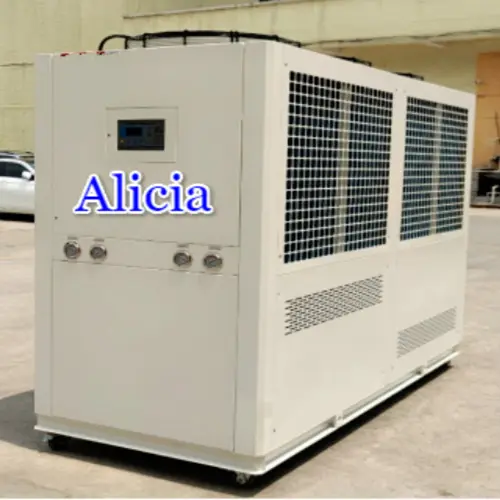
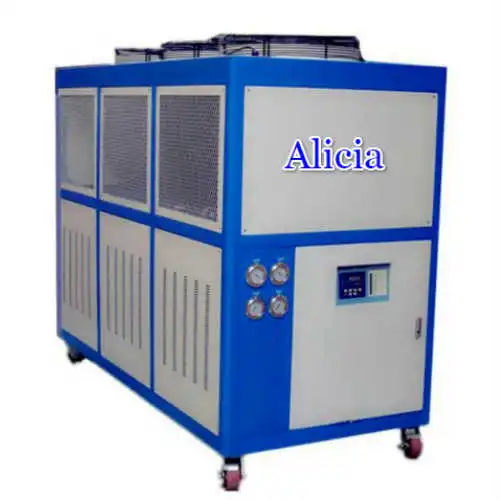
In the production of carbonated beverages (such as carbonated soft drinks and soda water), chillers are key auxiliary equipment. Their core function is to provide stable, low-temperature cold water to meet the "low-temperature environment" required during production. This is directly related to the efficient dissolution of carbon dioxide, the taste stability of the beverage, and production continuity. The following details the application of chillers in key stages of the production process:

I. Basic Functions of Chillers
A chiller uses core components such as a compressor, evaporator, and condenser to cool water to a specific temperature (usually 2-10°C, depending on the type of beverage). The chiller then delivers this low-temperature cold water through pipes to equipment on the production line that requires cooling (such as heat exchangers and jacketed tanks). This heat exchange removes heat from the product, thereby cooling the product.
II. Specific Applications in Carbonated Beverage Production
1. Cooling Syrup/Base (Pretreatment)
Carbonated beverage production typically uses a "syrup" (such as the concentrated syrup used in cola). The syrup must first be mixed with water in a suitable proportion to form a "base liquid."
Requirement: If the syrup or base liquid temperature is too high (e.g., above 25°C), it will affect the subsequent dissolution of carbon dioxide and easily breed microorganisms.
Chiller Function: Using a plate heat exchanger or coil heat exchanger, the mixed base liquid is cooled to 5-8°C. This low temperature not only inhibits microbial growth but also creates favorable conditions for subsequent carbonation (carbon dioxide dissolution).
2. Carbonation Process (Core Step)
Carbonation is the "soul" of carbon dioxide beverage production—it forcibly dissolves carbon dioxide gas into the base liquid, creating a bubbly texture.
Key Principle: The solubility of carbon dioxide is inversely proportional to temperature (lower temperature, higher solubility) and directly proportional to pressure. For example, at the same pressure, a liquid at 10°C can dissolve more carbon dioxide than one at 20°C. Chiller Function:
Before carbonation, the chiller further cools the base liquid to 2-4°C (even lower for some high-end products) to maximize the solubility of carbon dioxide.
Carbonation equipment (such as carbonation towers and venturi tubes) typically has a built-in cooling jacket. The chiller continuously supplies low-temperature cold water through the jacket to maintain a low temperature environment in the liquid during the carbonation process, ensuring stable dissolution of carbon dioxide (avoiding gas evolution due to temperature fluctuations).
3. Rapid Cooling After Sterilization (Aseptic Production Requirements)
Some carbonated beverages (such as those containing fruit juice) require pasteurization (maintaining the temperature at 60-70°C for a period of time) to kill microorganisms.
Requirement: If natural cooling is used after sterilization, the liquid remains at a moderate temperature (30-50°C) for a prolonged period, which may cause flavor degradation (e.g., loss of aroma) and increase the risk of secondary contamination. Chiller's Function: Rapidly cools sterilized beverages using a heat exchanger, quickly reducing the temperature from 60-70°C to below 10°C. This locks in flavor and terminates the sterilization reaction, ensuring product quality.
4. Temperature Control Before Filling
Carbonated beverages must be kept at a stable, low temperature (typically 5-10°C) before filling.
Reason: If the temperature rises, dissolved carbon dioxide in the liquid will precipitate due to a decrease in solubility, causing "splashing" during filling (a sudden drop in pressure causing bubbles to boil over), which wastes material and affects filling accuracy.
Chiller's Function: Using a cooling jacket outside the insulated pipe or a "buffer cooling tank" before filling, a chiller can maintain a constant low temperature for the beverage, ensuring a smooth filling process. 5. Equipment and Environment Cooling (Auxiliary Function)
Some production equipment (such as CO2 storage tanks and high-pressure pumps) generates heat during operation due to compression and friction. Chillers can cool this heat through cooling cycles, ensuring stable equipment operation.
In production workshops with high temperatures, chillers can work in conjunction with air conditioning systems to lower the local ambient temperature, preventing excessive room temperature from affecting material cooling.
III. Summary: The Core Value of Chillers
In CO2 beverage production, chillers directly impact three key indicators by precisely controlling "low temperatures":
1. CO2 solubility: Low temperatures ensure sufficient bubbles in the beverage, preserving the taste;
2. Product stability: Low temperatures inhibit microbial growth and flavor degradation, extending shelf life;
3. Production efficiency: They prevent material waste and equipment failure caused by temperature fluctuations, ensuring continuous production.
Therefore, chillers are called the "temperature stewards" of CO2 beverage production lines and are a key piece of equipment for ensuring product quality.




 Why are closed-circuit cooling towers needed to make cheese?
 closed-circuit cooling tower systems for process cooling applications
 How are chillers used in the cosmetics manufacturing industry?
 How are water chillers used in the detergent manufacturing industry?


