Based on the actual working conditions of bee product (honey, royal jelly, bee pollen, propolis) processing, I've provided a straightforward and foolproof chiller selection guide. You can use it directly for purchasing or recommending to clients.
I. First, consider the processing type to determine temperature requirements.
Bee product processing is highly sensitive to temperature; choosing the wrong temperature will directly affect quality.
1.Simply remember: For honey concentration only: a standard chiller with a temperature range above 5℃ is sufficient.
2.For royal jelly and pollen processing: a low-temperature chiller around 0℃ is required.
II. Select cooling capacity based on equipment power (most critical).
In bee product processing, chillers primarily cool vacuum concentrators, heat exchangers, and mixing tanks.
Quick Estimation Formula
1kW Heating Power → 0.8~1.0kW Cooling Capacity
1m³ Concentrator → 3~5HP Chiller
Common Matching (Directly Copy)
1.Small Workshops: 50~100L Concentrator → 3HP Chiller
2.Medium-sized Processing Plants: 200~500L → 5~10HP
3.Large Production Lines: 1000L and above → 15~25HP
III. Must Select “Food-Grade” Configuration
Bee products are food; failure to meet hygiene standards will result in immediate disposal.
Mandatory Requirements:
Water tank, water pump, and piping are all 304/316 stainless steel Shell-and-tube evaporators or stainless steel coils, rust-free and dirt-free, Avoid using ordinary carbon steel or galvanized pipes
IV. Cooling Method: Air Cooling vs. Water Cooling
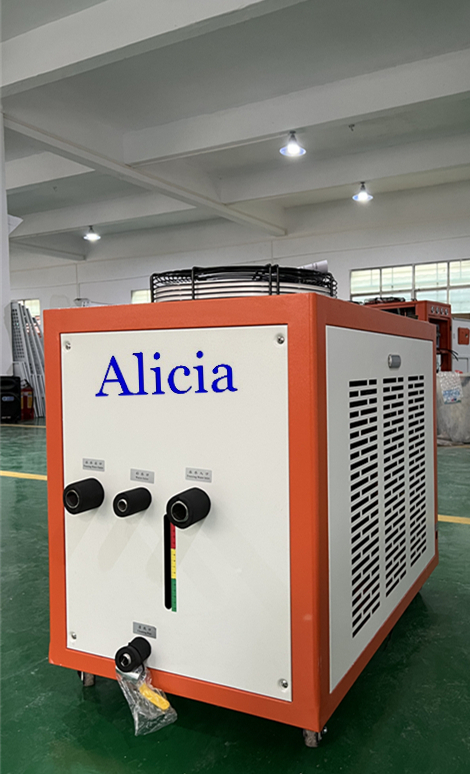
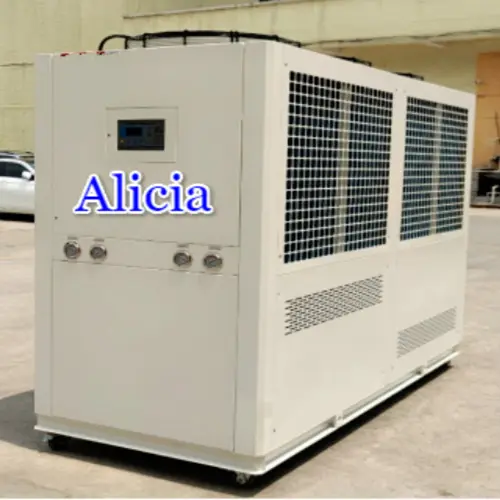
1.Clean workshops, small spaces, and water-scarce areas → Choose an air-cooled chiller; installation is simple.
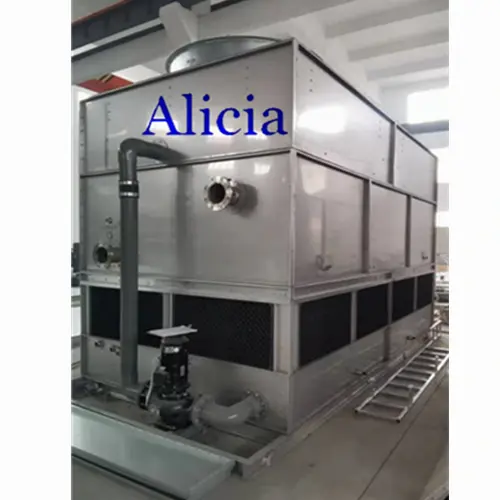
2.Large-scale production lines, high ambient temperatures, and continuous 24-hour production → Choose a water-cooled chiller for greater stability and energy savings.
3.For bee product processing, air cooling is generally preferred for its convenience and hygiene.
V. Control Precision Requirements
1.Ordinary honey concentration: ±1~2℃ is sufficient.
2.Royal jelly and high-activity products: ±0.5℃ high-precision temperature control is recommended. Choose models with:
Intelligent constant temperature; Water shortage/overload/high/low pressure protection; Remote monitoring capability.
VI. Avoidance Tips (Very Practical)
1.Do not buy cheap, generic brands. Insufficient cooling will lead to slow concentration, honey discoloration, and loss of activity.
2.In summer, high temperatures require a margin of safety. When the ambient temperature is above 35℃, the cooling capacity will decrease; it is recommended to upgrade to a higher-end model.
3.Water pump flow rate must be matched. Insufficient flow rate results in poor cooling and slow cooling of the concentration pot.
4. A closed-loop circulation system is essential. Open water tanks are prone to dust and insects, which does not meet food hygiene standards.
VII. Final Summary (for your convenience):
1.Honey Concentration: 5-15℃, 304 stainless steel, air-cooled, 3-10HP
2.Royal Jelly/Pollen Production: 0-5℃ low-temperature machine, high-precision temperature control
3.Large Production Line: Water chiller, 15HP or higher, equipped with a stainless steel circulation system
Please send me the following information, and I will directly calculate the most suitable chiller model, cooling capacity, temperature, and configuration for you, all in one step:
1.What will you mainly process? (Honey/Royal Jelly/Pollen/Propolis, multiple selections are also acceptable)
2.Vacuum Concentrator: What is the volume in liters? What is the heating power in kW?
3.Approximately how many kilograms/tons will you process per day?
4.Workshop Environment: Indoor or outdoor?
5.What is the highest temperature?
6.Water Source: Is there tap water/well water available for easy heat dissipation?
7.Are there any water quality requirements: Must it be all stainless steel?
Just reply with the numbers in the table, and we will provide you with a precise selection plan.




 Why are closed-circuit cooling towers needed to make cheese?
 closed-circuit cooling tower systems for process cooling applications
 How are chillers used in the cosmetics manufacturing industry?
 How are water chillers used in the detergent manufacturing industry?


