We use cookies to improve your online experience. By continuing browsing this website, we assume you agree our use of cookies.

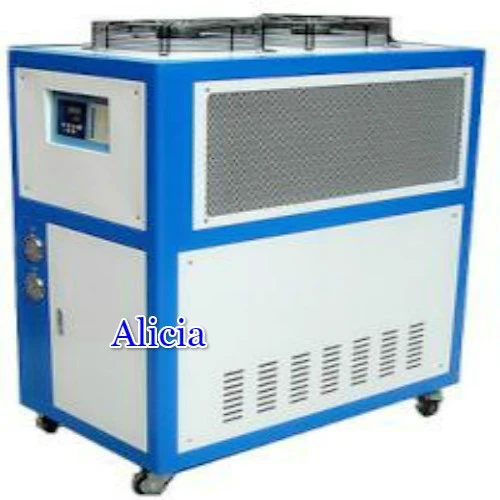
water Chiller air cooled For Soaps Stamping Mold cooling

Model AT-05A
Cooling capacity 16.95kw/ 14577kcal/h/ 4.8RT
water flow 2.91m3/h
compressor power 5hp/ 3.75kw
Tank capacity 80L
Pipe size 20DN/0.75Inch
built in pump 0.75kw
Machine weight 176kg
Machine size 1.1x0.5x1.35m
Warranty 1 year warrant
Description
Description
Soap production involves various heating and cooling processes, such as saponification, drying, and molding. Our industrial water chiller plays a critical role in maintaining the desired temperature and ensuring the quality and consistency of the soap production process.
 
Here are some key applications and advantages of our air-cooled water chiller in soap production:
Cooling of Saponification Reactions: During the saponification process, heat is generated as the fats/oils react with alkali. Our water chiller efficiently removes excess heat, allowing for precise temperature control and facilitating the desired chemical reaction.
 
Mold Cooling: Soap molding requires rapid cooling to solidify the soap mixture and achieve the desired shape and texture. Our water chiller delivers quick and efficient cooling, accelerating the molding process and improving production output.
 
Batch Cooling: After the saponification and molding processes, the soap batches need to be cooled to enhance their hardness and durability. Our industrial water chiller provides consistent and controlled cooling, ensuring the desired properties of the finished soap products.
 
Equipment Cooling: Soap manufacturing involves the use of various equipment such as mixers, homogenizers, and extruders. Our water chiller effectively cools these equipment, preventing overheating and prolonging their lifespan.
 
Energy Efficiency: Our air-cooled design eliminates the need for a separate cooling tower or water source, making it a cost-effective and environmentally friendly solution. It reduces water consumption and energy usage, resulting in lower operating costs and a smaller carbon footprint.
 
Customizable Solutions: We understand that soap production facilities have unique cooling requirements. Our water chiller machines are customizable to accommodate specific production volumes, temperature ranges, and other process parameters, ensuring a tailored solution for your soap manufacturing needs.
 
In summary, our Hot selling model 5HP/10HP / 20HP /30HP Air Cooled Industrial Water Chiller Machine is designed to meet the cooling demands of soap production. Its applications in saponification, mold cooling, batch cooling, equipment cooling, energy efficiency, and customization make it an essential asset for soap manufacturers seeking optimal cooling performance and reliable production processes. Contact us today to learn more about how our water chiller can enhance your soap production efficiency and quality.
 
The Chiller for soap industry usually use an air cooled scroll chiller. An air-cooled scroll water chiller is a type of cooling system that uses the scroll compressor technology to remove heat from water. It is designed to provide chilled water for various industrial and commercial applications.
chiller to freeze the soap moulds

Core Function for Soap Mould Freezing Chillers
It circulates a glycol-water solution (anti-freeze, non-corrosive) through the soap mould’s internal channels. The chiller’s refrigeration cycle cools the solution, which absorbs heat from the mould and the exothermic soap mixture—speeding up solidification, reducing demoulding time, and ensuring consistent soap shape/quality.

Working Principle of Soap Mould Freezing Chillers

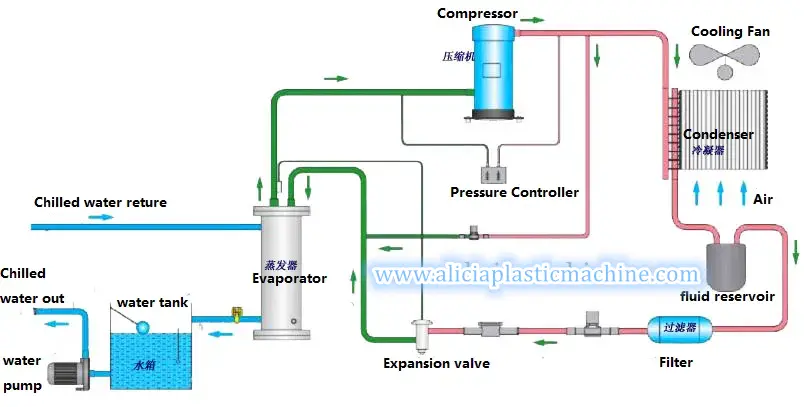
The chiller operates based on the refrigeration cycle. The compressor compresses the refrigerant, raising its temperature and pressure. The high-temperature, high-pressure refrigerant gas then enters the air-cooled condenser, where it releases heat to the ambient air and condenses into a liquid. The liquid refrigerant passes through the expansion valve, reducing its pressure and temperature, and then enters the evaporator. In the evaporator, the refrigerant absorbs heat from the glycol-water solution, cooling it down. The cooled glycol-water solution is then pumped to the soap molds to absorb the heat generated during the soap solidification process.

Structure diagram for air cooled die chiller

Key Requirements for "Freezing" Soap Moulds Chillers
Temperature Range: Choose a chiller rated for 5–15°C (critical for "freezing" moulds without damaging soap texture). Avoid chillers with minimum setpoints above 10°C if faster cooling is needed.
Rapid Cooling Performance: Prioritize chillers with high cooling capacity per unit size (kW/RT) to quickly pull down mould temperatures—look for efficient compressors (Copeland/Daikin) and large evaporators for fast heat transfer.
Glycol Compatibility: Use food-grade glycol (propylene glycol) to avoid contaminating soap. Ensure the chiller’s tank, pipes, and pump are made of stainless steel (304/316) for corrosion resistance.
Flow Stability: Moulds (especially multi-cavity or narrow-channel designs) need steady, sufficient flow (≥2–3 m³/h for small batches) to prevent uneven cooling. Opt for chillers with variable-speed pumps if moulds have different flow needs.
Sizing Tips for Soap Mould Freezing Chillers
Calculate heat load with a focus on "rapid cooling": Use the formula (mass of soap × specific heat × temp drop) ÷ cooling time, but shorten cooling time (e.g., 30 mins instead of 1 hour) for "freezing" needs.
Add a 20–30% safety margin (higher than standard cooling) to account for the chiller’s need to lower moulds to near-freezing temps quickly.
For air-cooled models: If installed in warm workshops (≥30°C), upsizing by 10–15% ensures the chiller doesn’t lose efficiency when dissipating heat to ambient air.
Selection Considerations of Soap Mould Freezing Chillers
Cooling Capacity: Calculate the total heat load from soap solidification (exothermic reaction), mold heat capacity, and production speed. Add a 10–20% safety margin. For example, if the calculated heat load is 10 kW, choose a chiller with 11–12 kW (≈3.1–3.4 RT) cooling capacity.
Flow Rate: Ensure the built - in pump can provide sufficient glycol solution flow to cover all molds and achieve efficient heat transfer. Narrow - channel molds may require higher flow rates.
Temperature Range: Most soap mold cooling needs 10–25°C; choose a chiller with a suitable rated range (e.g., 5–35°C) to ensure stable operation.
Ambient Conditions: In high - temperature environments (≥35°C), consider upsizing an air - cooled chiller by 5–10% to compensate for reduced heat - dissipation efficiency.
Example Suitable Model of Soap Mould Freezing Chillers
Cooling Capacity: 12 kW (3.4 RT) – fits mid-sized batches (150–200kg soap per batch, cooling from 70°C to 25°C in 30 mins)
Temp Range: 5–35°C (adjustable to 8–12°C for mould freezing)
Flow Rate: 3.2 m³/h (built-in stainless steel pump)
Tank Capacity: 100L (food-grade, corrosion-resistant)

Use Scenarios
Soap Manufacturing Process Temperature Control
In soap production lines, this type of water cooled chiller machine maintains steady cooling of soap molds, preventing overheating and ensuring product quality. Its air-cooled design suits factories without the infrastructure for water-cooled systems, reducing complexity. The glycol solution’s freeze protection allows reliable function in chilled environments, making it applicable for facilities in colder climates or those implementing batch processing requiring rapid temperature adjustments.

OEM/ODM Sourcing for Industrial Facilities
For distributors and importers specializing in plastic auxiliary equipment, the industrial water chiller offers straightforward integration into OEM/ODM product lines for temperature regulation. Its specifications and safety features facilitate compliance with varied industrial standards. The chiller’s compact footprint and standard interfaces simplify customization and after-market support, factors considered in bulk procurement and distribution deals within industrial cooling categories.
 
 
FAQ

What are the main benefits of using an air-cooled glycol chiller for soap mold cooling?
Our air-cooled glycol chiller efficiently stabilizes soap mold temperatures by circulating a glycol-water solution, eliminating the need for complex water circulation systems like cooling towers. This ensures easier installation, reduced maintenance, and dependable cooling performance in various manufacturing environments.

Can you customize the cooling capacity or specifications of the water chiller machine for my facility?
We offer flexible options to meet diverse industrial needs. Our team can assist in specifying the appropriate industrial water chiller capacity or adjusting features such as tank size and compressor power to match your soap production requirements while maintaining optimal efficiency and safety.

How do you ensure reliable operation and protection in your water cooled industrial chiller?
Our chillers integrate imported compressors from brands like Daikin or Copeland, providing high efficiency and low noise. Multiple safety protections are built-in, including compressor overload and voltage safeguards, which help prevent downtime and protect your investment during continuous soap mold cooling operations.

What installation and maintenance support do you provide for the industrial water chiller?
We provide detailed installation guidance tailored to the air-cooled glycol chiller, highlighting its minimal footprint and the advantage of no cooling tower need. Our experts also offer maintenance tips for the water chiller machine, helping ensure long-term performance and efficient temperature control in your production line. 
Send your message to us
please select your country
  • Afghanistan
  • Aland Islands
  • Albania
  • Algeria
  • American Samoa
  • Andorra
  • Angola
  • Anguilla
  • Antigua and Barbuda
  • Argentina
  • Armenia
  • Aruba
  • Australia
  • Austria
  • Azerbaijan
  • Bahamas
  • Bahrain
  • Bangladesh
  • Barbados
  • Belarus
  • Belgium
  • Belize
  • Benin
  • Bermuda
  • Bhutan
  • Bolivia
  • Bosnia and Herzegovina
  • Botswana
  • Bouvet Island
  • Brazil
  • British Indian Ocean Territory
  • British Virgin Islands
  • Brunei Darussalam
  • Bulgaria
  • Burkina Faso
  • Burundi
  • Cambodia
  • Cameroon
  • Canada
  • Cape Verde
  • Caribbean Netherlands
  • Cayman Islands
  • Central African Republic
  • Chad
  • Chile
  • Christmas Island
  • Cocos Islands
  • Colombia
  • Comoros
  • Congo
  • Cook Islands
  • Costa Rica
  • Cote D'ivoire
  • Cuba
  • Curaçao
  • Cyprus
  • Czech Republic
  • Democratic Republic of the Congo
  • Denmark
  • Djibouti
  • Dominica
  • Ecuador
  • Egypt
  • El Salvador
  • Equatorial Guinea
  • Eritrea
  • Estonia
  • Ethiopia
  • Falkland Islands
  • Faroe Islands
  • Fiji
  • Finland
  • France
  • French Guiana
  • French Polynesia
  • French Southern Territories
  • Gabon
  • Gambia
  • Georgia
  • Germany
  • Ghana
  • Gibraltar
  • Greece
  • Greenland
  • Grenada
  • Guadeloupe
  • Guam
  • Guatemala
  • Guernsey
  • Guinea
  • Guinea-Bissau
  • Guyana
  • Haiti
  • Heard Island and Mcdonald Islands
  • Honduras
  • Hong Kong, China
  • Hungary
  • Iceland
  • India
  • Indonesia
  • Iran
  • Iraq
  • Ireland
  • Isle of Man
  • Israel
  • Italy
  • Jamaica
  • Japan
  • Jordan
  • Kazakhstan
  • Kenya
  • Kiribati
  • Korea
  • Kosovo
  • Kuwait
  • Kyrgyzstan
  • Laos
  • Latvia
  • Lebanon
  • Lesotho
  • Liberia
  • Liechtenstein
  • Lithuania
  • Luxembourg
  • Macedonia
  • Madagascar
  • Malawi
  • Malaysia
  • Maldives
  • Mali
  • Malta
  • Marshall Islands
  • Martinique
  • Mauritania
  • Mauritius
  • Mayotte
  • Mexico
  • Micronesia
  • Moldova
  • Monaco
  • Montenegro
  • Montserrat
  • Morocco
  • Mozambique
  • Myanmar
  • Namibia
  • Nauru
  • Nepal
  • Netherlands
  • Netherlands Antilles
  • New Caledonia
  • New Zealand
  • Nicaragua
  • Niger
  • Nigeria
  • Niue
  • Norfolk Island
  • Northern Mariana Islands
  • Norway
  • Oman
  • Pakistan
  • Palau
  • Palestine
  • Panama
  • Papua New Guinea
  • Paraguay
  • Peru
  • Philippines
  • Pitcairn Islands
  • Poland
  • Portugal
  • Puerto Rico
  • Qatar
  • Reunion
  • Romania
  • Russia
  • Rwanda
  • Saint Barthélemy
  • Saint Helena
  • Saint Kitts and Nevis
  • Saint Lucia
  • Saint Martin
  • Saint Pierre and Miquelon
  • Saint Vincent and the Grenadines
  • San Marino
  • Sao Tome and Principe
  • Saudi Arabia
  • Senegal
  • Serbia
  • Seychelles
  • Sierra Leone
  • Singapore
  • Sint Maarten
  • Slovakia
  • Slovenia
  • Solomon Islands
  • Somalia
  • South Africa
  • South Georgia and The South Sandwich Islands
  • Spain
  • Sri Lanka
  • State of Libya
  • Sudan
  • Suriname
  • Svalbard and Jan Mayen
  • Swaziland
  • Sweden
  • Switzerland
  • Syrian Arab Republic
  • Tajikistan
  • Tanzania
  • Thailand
  • The Republic of Croatia
  • Togo
  • Tokelau
  • Tonga
  • Trinidad and Tobago
  • Tunisia
  • Turkey
  • Turkmenistan
  • Turks and Caicos Islands
  • Tuvalu
  • Uganda
  • Ukraine
  • United Arab Emirates
  • United Kingdom
  • United States
  • United States Minor Outlying Islands
  • Uruguay
  • US Virgin Islands
  • Uzbekistan
  • Vanuatu
  • Vatican City State
  • Venezuela
  • Vietnam
  • Wallis and Futuna Islands
  • Western Sahara
  • Western Samoa
  • Yemen
  • Zambia
  • Zimbabwe
ver_code