In the water treatment industry, both
water chillers and cooling towers play a core role in temperature control and efficient resource utilization, but their application scenarios and functional emphases differ. The following describes specific applications of each:

I. Chiller Applications: Precise Temperature Control to Ensure Process Stability
The core function of a chiller is to provide low-temperature cooling water (typically 5-20°C) through a compression-refrigeration cycle, while achieving precise temperature control (within ±1°C). Chillers are primarily used in water treatment processes requiring strict temperature control to prevent the negative impact of high temperatures on equipment, materials, or reaction efficiency. Their application focuses on temperature-sensitive water treatment processes:
1. Cooling in Membrane Separation Processes
Membrane separation (such as reverse osmosis (RO), ultrafiltration (UF), and nanofiltration (NF)) is a commonly used high-precision filtration technology in water treatment. However, membrane modules are extremely sensitive to temperature:
Increased water temperature can cause membrane pore size expansion and accelerate material aging. Furthermore, reduced feed viscosity can increase the risk of membrane fouling and reduce filtration efficiency. Chillers can directly cool the membrane module surface or the feed flow path through plate heat exchangers or coils, stabilizing the temperature within the membrane's optimal operating range (for example, RO membranes typically need to be controlled below 25°C), extending membrane life and maintaining water production.
2. Temperature Control for Chemical Reaction Water Treatment Processes
Some water treatment processes (such as oxidation, reduction, and coagulation) are temperature-sensitive and require a chiller to precisely control the reaction environment.
For example, when using the Fenton oxidation process to treat refractory organic wastewater, the reaction between Fe²⁺ and H₂O₂ releases a large amount of heat. Excessive temperatures can lead to rapid H₂O₂ decomposition and reduced reagent utilization. Chillers can control the reaction system temperature at 20-30°C, improving oxidation efficiency.
For another example, when using low-temperature crystallization to remove salt from high-salinity wastewater (such as pre-cooling before evaporation and crystallization), chillers can provide a low-temperature environment to promote salt precipitation and reduce subsequent evaporation energy consumption. 3. Equipment Operation Heat Dissipation
Some high-power equipment in water treatment (such as high-pressure pumps, precision filters, and ozone generators) generates significant heat during operation. Prolonged operation at high temperatures can lead to equipment failure.
Chillers can control equipment temperatures within a safe range (e.g., motor temperature ≤ 60°C) by cooling the equipment's lubricating oil lines, motor casing, or internal circulation system, extending equipment life.
II. Cooling Tower Applications: Circulating Cooling and Water Conservation
The core function of a cooling tower is to reduce the temperature of circulating water (typically 3-5°C above the ambient wet-bulb temperature) through heat exchange between air and water (evaporative heat dissipation + contact heat dissipation). This allows for the reuse of cooling water and reduces fresh water consumption. Its application scenarios focus on circulating cooling systems with high flow rates and medium to low temperature differentials:
1. Circulating cooling of large water treatment equipment
High-power equipment (such as pumps, fans, and air compressors) in water treatment plants (e.g., municipal sewage treatment plants and industrial wastewater treatment plants) requires continuous cooling during operation. Cooling towers can be used in conjunction with circulating water systems to achieve multiple uses for water.
For example, when aeration fans (which can reach hundreds of kilowatts) operate in sewage treatment plants, the motor windings and bearings generate heat, requiring cooling water. The cooling water absorbs heat, raising its temperature (typically from 30°C to 40°C). After heat exchange with the air in the cooling tower, it cools down to approximately 32°C and can be re-fed into the fan cooling system, reducing the need for fresh water replenishment (which only replaces evaporation and splashback losses, approximately 1-3% of the circulating water volume).
2. Process Water Temperature Control
Some water treatment processes are sensitive to ambient water temperature (such as biological treatment and evaporation concentration). Cooling towers can indirectly control the process environment by regulating the circulating water temperature.
In the activated sludge process at municipal wastewater treatment plants, the optimal activity temperature for microorganisms (such as aerobic bacteria) is 15-30°C. High water temperatures in the summer (e.g., exceeding 35°C) can reduce microbial activity. Cooling towers can be used to cool the circulating water, which is then passed through the coils or jackets of the aeration tanks to indirectly lower the water temperature and maintain microbial activity.
In the evaporation concentration process for industrial wastewater, the condensation of secondary steam from the evaporator generates heat. Directly discharging the heat would waste energy. Cooling towers can cool the circulating water used to condense the secondary steam, allowing it to be reused in the condensation system, reducing energy consumption.
3. Water-Saving Retrofits for High-Water-Consumption Systems
Traditional open cooling systems (e.g., direct cooling water discharge) consume a lot of water. Cooling towers can save water through "circulating cooling."
For example, in ultrapure water preparation systems in the electronics industry, the high-pressure pump and membrane housing of the reverse osmosis equipment generate heat. Traditionally, tap water is used to cool the water directly before discharge, resulting in high water consumption. By switching to a cooling tower + circulating water pump system, the cooling water can be recycled, achieving a water saving rate of over 90%.
In large-scale water treatment systems, the two are often used in combination to achieve both precise temperature control and energy and water conservation.
For example, in the membrane separation system of a pharmaceutical wastewater treatment plant, a cooling tower first cools the circulating water from 40°C to 30°C, and then further cools it to 15°C through a chiller. This not only reduces the load on the chiller (saving energy) but also ensures the low temperature required by the membrane modules (stable water production). Summary Chillers focus on "high-precision low-temperature control" to ensure stable operation of temperature-sensitive processes (such as membrane separation and chemical reactions) and equipment. Their core value is "maintaining process efficiency and equipment life."
Cooling towers focus on "circulating water cooling and water conservation," enabling reuse of cooling water through air heat exchange. Their core value is "reducing water consumption and operating costs."
Both are key temperature control devices in the water treatment industry. Selection should be based on process temperature requirements, energy costs, and water quality characteristics (e.g., selecting corrosion-resistant materials to prevent damage to the equipment from impurities or corrosive substances in the treated water).




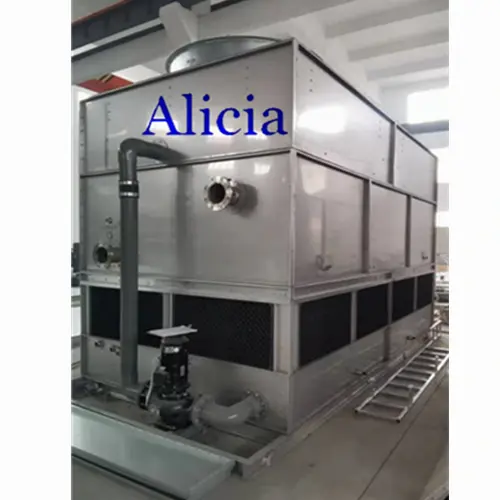 Why are closed-circuit cooling towers needed to make cheese?
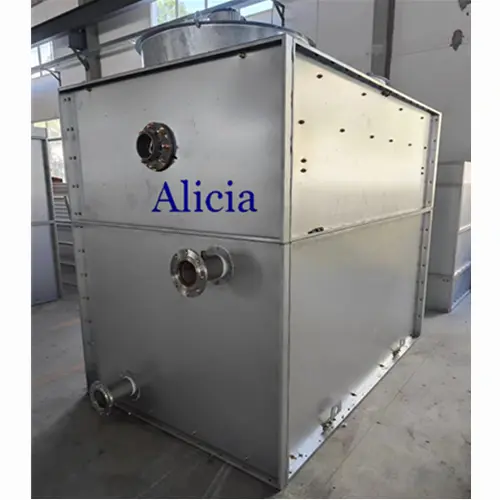 closed-circuit cooling tower systems for process cooling applications
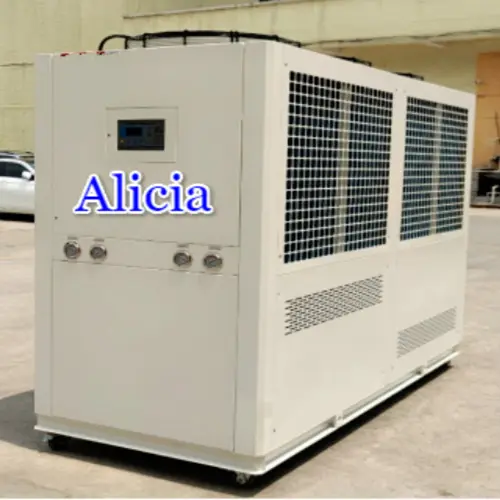 How are chillers used in the cosmetics manufacturing industry?
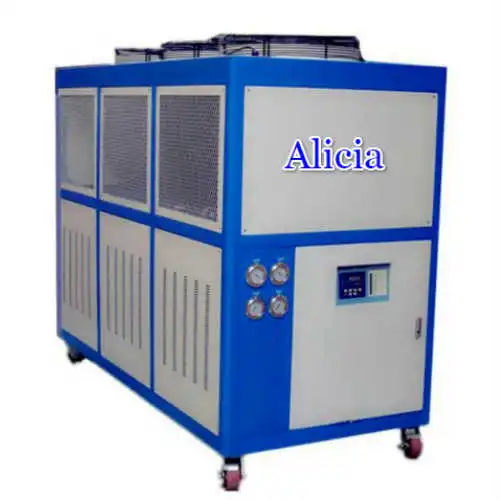 How are water chillers used in the detergent manufacturing industry?


