plastic recycling washing drying line for PET bottles
A plastic recycling washing drying line for PET bottles is a production line that can recycle waste PET bottles through a series of processes such as washing and drying to obtain clean and dry PET bottle flakes. Here is an introduction to its relevant information:
Process Flow of plastic recycling washing drying line for PET bottles
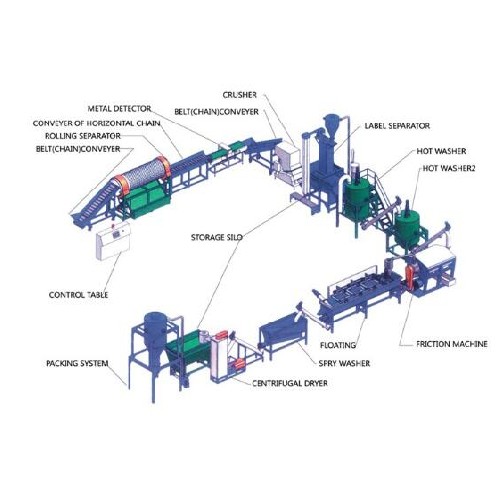
- Debranding and Sorting: The recovered PET plastic bottles first pass through a de - labeling machine to remove the labels on the bottle body. Then, they go through a planar sorting conveyor to pick out varicolored bottles and residual impurities.
- Crushing: The sorted PET bottles enter a crusher and are crushed into small flakes by high - speed rotating blades.
- Washing: The crushed PET bottle flakes first enter a rinsing tank for separation to realize the separation of PET bottle flakes from PP label paper and bottle caps. Then, they enter a high - temperature pot for heating and washing. After that, they enter the rinsing tank again to remove the cleaning agent. For bottles with high pollution levels, a multi - stage washing process such as neutralization washing may be added.
- Dehydration and Drying: After washing, the PET bottle flakes enter a dehydrator for centrifugal dehydration, and then are further dried by a hot - air dryer to make the moisture content reach the required standard.
Main Equipment of plastic recycling washing drying line for PET bottles
- Crusher: It is equipped with a motor and blades. The motor drives the blades to rotate at high speed to cut the PET bottles into small pieces or flakes. A sieve is set in the crusher to control the size of the plastic pieces.
- Washing Equipment: Including rinsing tanks, friction washers, and hot - wash tanks. The rinsing tank is used for the separation of bottle flakes and impurities through the density difference. The friction washer removes the dirt on the surface of the bottle flakes through the friction of the rotating friction roller. The hot - wash tank uses 70 - 80 °C hot water and adds lye to remove stubborn dirt.
- Dehydrator and Dryer: The dehydrator usually adopts a centrifugal dehydration method to remove most of the moisture in the bottle flakes. The dryer uses hot - air drying to further reduce the moisture content of the bottle flakes.
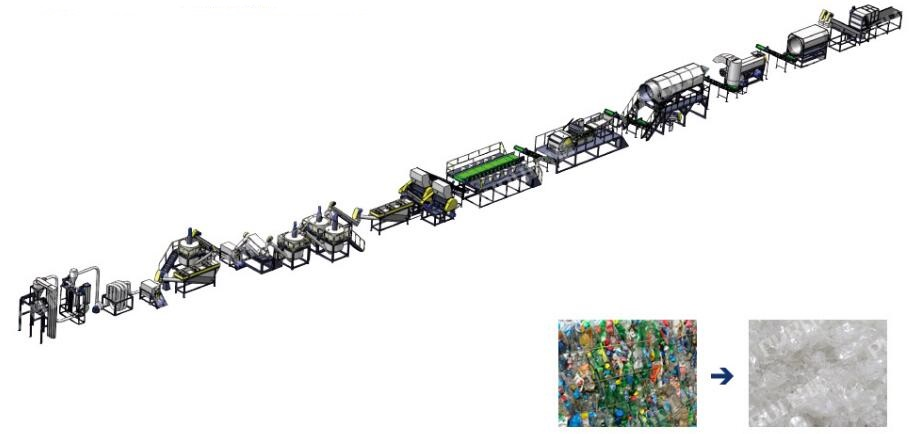 Features of plastic bottle recycling and washing production line:1. Exquisite appearance, low energy consumption, high output, practical, and reliability.2. The brand-new rinsing device can be washed as soon as it is broken, which greatly improves the production efficiency, and the washing material is clean, which meets the requirements of first-class cleaning.3. The plastic bottle recycling and cleaning equipment has a high degree of automation. During the production process, only 3-5 operators are required. The output is 200-1000kg/h (also can be designed according to user requirements).4. The water content of the label paper and the bottle flakes after cleaning are both below 1%. It can save a lot of subsequent energy consumption while ensuring the quality of bottle flakes.
Application Scope of plastic recycling washing drying line for PET bottles
The clean PET flakes produced by the production line can be widely used in the manufacture of recycled PET bottles, fibers, films, sheets, injection - molded products, etc.
The core advantages of a plastic recycling washing drying line for PET bottles lie in highly efficient impurity removal, stable product quality output, and strong adaptability to large-scale recycling, which comprehensively solve the key pain points of PET bottle recycling.
1. Excellent Cleaning & Impurity Removal Effect
This is the most core advantage of the production line, directly determining the value of recycled PET flakes.
- It adopts a multi-stage combined washing process (including floating separation, friction washing, high-temperature alkaline washing, and rinsing). This process can remove over 98% of impurities, such as PP bottle caps, paper labels, oil stains, and adhesives on bottle surfaces.
- The density difference principle is used in floating separation to separate PET flakes (density 1.38g/cm³) from lighter impurities like PP/PE labels (density <1g/cm³), ensuring no cross-material mixing.
2. Stable & High-Quality Recycled Flakes
The production line can strictly control the two key indicators of recycled PET flakes: moisture content and purity.
- After centrifugal dehydration + hot-air drying, the moisture content of the final flakes can be stably controlled at 0.5%–2%, which fully meets the requirements of subsequent granulation or direct processing (moisture exceeding 3% will cause bubbles in the product).
- The impurity content of the flakes is less than 0.1%, which ensures that the recycled PET can be used in high-value fields such as food-grade packaging (after further purification) or high-quality polyester fibers, rather than only low-end products.
3. High Efficiency & Large-Scale Processing Capability
It is far more efficient than manual or single-machine processing, and can meet the needs of industrialized recycling.
- The processing capacity covers a wide range, from 500 kg/h (small-scale) to 6000 kg/h (large-scale), which can match the recycling volume of waste PET bottles in different regions.
- The whole line adopts automatic control (PLC system), with continuous feeding, processing, and discharging. It only needs 2–3 operators to monitor, which greatly reduces labor intensity and avoids human errors.
4. Strong Adaptability & Cost-Effectiveness
It can cope with different types of waste PET bottles and help enterprises control recycling costs.
- It is compatible with various PET bottle types, such as mineral water bottles, cola bottles, edible oil bottles, and pesticide bottles. It only needs to adjust the washing time or temperature slightly, without replacing the main equipment.
- Most equipment adopts modular design. Enterprises can increase or decrease functional modules (such as adding a label sorting machine or a metal remover) according to their own needs, avoiding unnecessary investment. At the same time, the water in the washing process can be recycled after treatment, reducing water consumption by about 30%.


