


A Customer in Mauritius purchased 10hp air cooled chiller for preform mold
PET preform and bottle manufacturer in Mauritius, purchased 10hp air cooled chiller use for cooling preform mold.
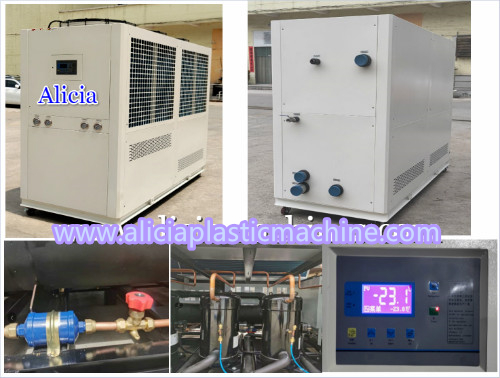
The core function of a chiller in preform molds is to stabilize temperature, rapidly remove heat, and ensure uniform cooling and shaping of the preform, thereby shortening the cycle time and improving yield.
I. Why do preform molds need chillers?
During PET preform injection molding, the mold needs to maintain a low temperature of 10–25℃ (adjusted according to the bottle shape).
High-temperature melt (approximately 280℃) is injected into the mold cavity. If the heat is not removed in time, it will lead to:
Uneven preform shrinkage, deformation, and surface fogging/bubbling;
Prolonged cooling time, resulting in decreased production capacity;
Prolonged high temperature in the mold, leading to thermal fatigue and shortened lifespan.
II. Working Principle (Three Major Circulations)
1. Chilled Water Circulation (Mold Side)
The chiller produces 7–12℃ low-temperature water, which is pumped into the internal cooling water circuit of the mold.
The chilled water flows through the mold cavity/core, removing heat from the melt and mold, raising the water temperature to 12–18℃.
The warm water, after absorbing heat, flows back to the chiller evaporator, completing the circulation.
2. Refrigerant Circulation (Internal to the Chiller)
Evaporator: The refrigerant absorbs heat from the warm water and evaporates into a low-temperature, low-pressure gas.
Compressor: Compresses the gas into a high-temperature, high-pressure gas (approximately 80–100℃).
Condenser: The high-temperature gas exchanges heat with the outside environment (air/cooling tower water), condensing into a high-pressure liquid.
Expansion Valve: The liquid is throttled, depressurized, and cooled, returning to the evaporator, in a continuous cycle.
3. Heat Dissipation Circulation (Chiller → Environment)
Air-cooled: The condenser fan directly dissipates heat to the environment, simplifying installation.
Water-cooled: The condenser is connected to a cooling tower, dissipating heat through water evaporation within the tower, resulting in higher efficiency.
III. Specific Applications in Preform Molds
Mold Water Circuit Design: Circulating cooling water circuits are evenly distributed throughout the mold cavity, core, and hot runner plate to ensure uniform temperature (±0.5℃).
Multi-cavity molds (e.g., 16-cavity, 32-cavity) require independent circuits or balanced water circuits to avoid temperature differences between cavities.
Temperature Control Key Points
Preform Appearance/Transparent Parts: 10–15℃, rapid cooling, high transparency.
Thick-walled/Large Preforms: 15–25℃, prevents internal stress cracking.
Chiller Temperature Control Accuracy: ±0.5℃, ensuring batch consistency.
Value to Production
Shortened cooling time (60–80% of cycle time), increasing production capacity by 10–20%.
Reduced defects such as deformation, shrinkage, and bubbles, improving yield to 98%+.
Stable mold temperature, extending mold life by 30%+.
IV. Common Configurations and Selection
Chiller Types: Air-cooled (for small to medium production capacity, space-constrained); Water-cooled (for large production lines, 32 cavities or more).
Cooling Capacity Matching: Calculated based on the number of mold cavities, preform weight, and cycle time (e.g., 16-cavity 0.5L preforms, commonly uses a 10–15HP chiller). Key parameters: Outlet water temperature 7–12℃, temperature control accuracy ±0.5℃, flow rate ≥0.5L/min·cavity.
V. Brief Summary
The chiller uses refrigerant circulation for cooling and chilled water circulation for temperature control, providing a stable low temperature for the preform mold and achieving rapid and uniform cooling. It is an essential piece of equipment for high-capacity, high-quality preform production.


