We use cookies to improve your online experience. By continuing browsing this website, we assume you agree our use of cookies.

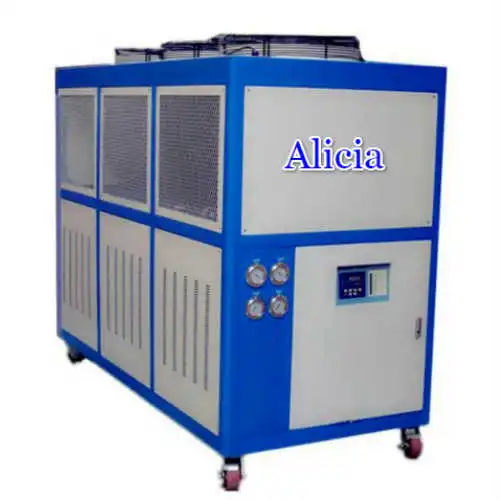
industrial air cooled chillers for cooling preform molds

Model AT-30-A
Cooling capacity 55kw/ 47300kcal/h/ 15RT
water flow 10.8 m3/h
compressor power 12.4kw*2pcs
Tank capacity 350L
Pipe size 3Inch
built in pump 3kw
Machine weight 980kg
Machine size 2120*1000*1960mm
Description
Description

Product introduction of industrial air cooled chillers for cooling preform molds
Industrial air-cooled chillers are critical equipment for cooling preform molds—core tools in the PET (polyethylene terephthalate) preform manufacturing process (used to make plastic bottles for beverages, cosmetics, and household products). Preform molding relies on precise temperature control to ensure mold cooling efficiency, preform quality (e.g., dimensional accuracy, surface finish), and production throughput. Air-cooled chillers excel here by eliminating the need for a dedicated water source (unlike water-cooled models) and delivering stable, targeted cooling to mold components. Below is a detailed breakdown of their role, advantages, working integration, and key selection criteria.


industrial chillers for cooling preform molds

1. Why Preform Molds Need Specialized Cooling

PET preforms are produced via injection molding: molten PET resin is injected into a preform mold (shaped like a small, thick-walled tube with a thread), then cooled rapidly to solidify the plastic before demolding. Poor cooling causes critical issues:
  • Dimensional Defects: Slow cooling leads to shrinkage, warping, or uneven wall thickness (e.g., preforms that are too thin at the neck, causing bottle leaks later).
  • Surface Imperfections: Overheating leaves blemishes (e.g., bubbles, scratches) or sticky surfaces (preforms stick to the mold, damaging both).
  • Reduced Throughput: Long cooling cycles slow down the molding machine (injection molding runs 24/7—even 10 extra seconds per cycle cuts daily output by thousands of preforms).
  • Mold Damage: Excess heat degrades mold steel or coatings (e.g., chrome plating), shortening mold life (preform molds cost $50k–$200k+ and have 100k–1M cycle lifespans).
Air-cooled chillers solve these by delivering consistent, low-temperature coolant to the mold, ensuring rapid, uniform cooling.

2. How Air-Cooled Chillers Integrate with Preform Molding

Preform molds have a built-in network of cooling channels (small holes drilled through the mold core, cavity, and runner system). Air-cooled chillers circulate a glycol-water mixture (or pure water, in mild climates) through these channels to remove heat. The process works in 4 steps:
  1. Coolant Cooling: The chiller’s compressor compresses refrigerant, which flows to the air-cooled condenser (fans blow ambient air over coils to dissipate heat, condensing the refrigerant into a liquid). The liquid refrigerant then passes through an expansion valve, lowering its temperature, before entering the evaporator (a heat exchanger). Here, the refrigerant absorbs heat from the glycol-water mixture, cooling it to the target temperature (typically 10–20°C for preform molds).
  2. Coolant Circulation: A high-pressure pump in the chiller pushes the cooled glycol-water mixture through insulated pipes to the preform mold’s cooling channels. The mixture flows through the mold’s core (inner part of the preform) and cavity (outer shape) first—these are the most critical areas for heat removal—then through the runner system (where molten resin flows to fill the cavities).
  3. Heat Extraction: As the cooled coolant circulates through the mold, it absorbs heat from the molten PET (which is injected at ~270–290°C). The now-warmed coolant flows back to the chiller’s evaporator to be re-cooled, creating a closed loop.
  4. Demolding & Cycle Repeat: Once the preform is cooled to ~40–60°C (solid enough to handle), the mold opens, and the preform is ejected. The chiller immediately re-circulates cooled coolant to the mold for the next injection cycle—ensuring no heat buildup between cycles.

Specifications:

Model

Unit

AT-5AC

AT-6AC

AT-8AC

Cooling Capacity


KW

14.5

17.5

27


Kcal/h

12758

15054

23220

Compressor

Input Power

KW

3.75

4.5

6

Rated Power

HP

5

6

8

Power


3PH-380V/50HZ

Evaporator

Type

Shell and Tube

Pie Diameter

inch

1”

1”

2”

Refrigerant

Type

R22

Quantity

KG

2

2.5

4

Condenser(air chiller)

Type

Finned Copper Tube + Low Noise Outer Rotor Fan

Fan Power

W

180*2

180*2

420*2

Water Tank Capacity


Liter

45

45

80

Pump

Power

KW

0.75

0.75

1.5

HP

1

1

2

Distance

m

35

35

15

Flow Rate

L/min

110

110

360

Safety Protection

High and Low Pressure Protection, Overload Protection,Overtemperature Protection, Phase Sequence Protection,etc.

Dimensions(L*W*H)


mm

1280*680*1225

1280*680*1225

1550*850*1508


Product Details

 01  Microcomputer LCD Controller

▪ Simultaneously displays the cold water outlet and the set temperature; ▪ Easy to operate with accuracy of controlling water temperature within 3℃ to 50℃.


 02  Famous Band Compressors

Using famous brand Copeland compressor, with lower noise and less vibration, efficient and energy saving.


 03  Shell&Tube Evaporators

Shell and tube evaporator adopts high-precision internal threaded copper tube design with larger heat exchanging area for higher efficiency and maximizing system performance.
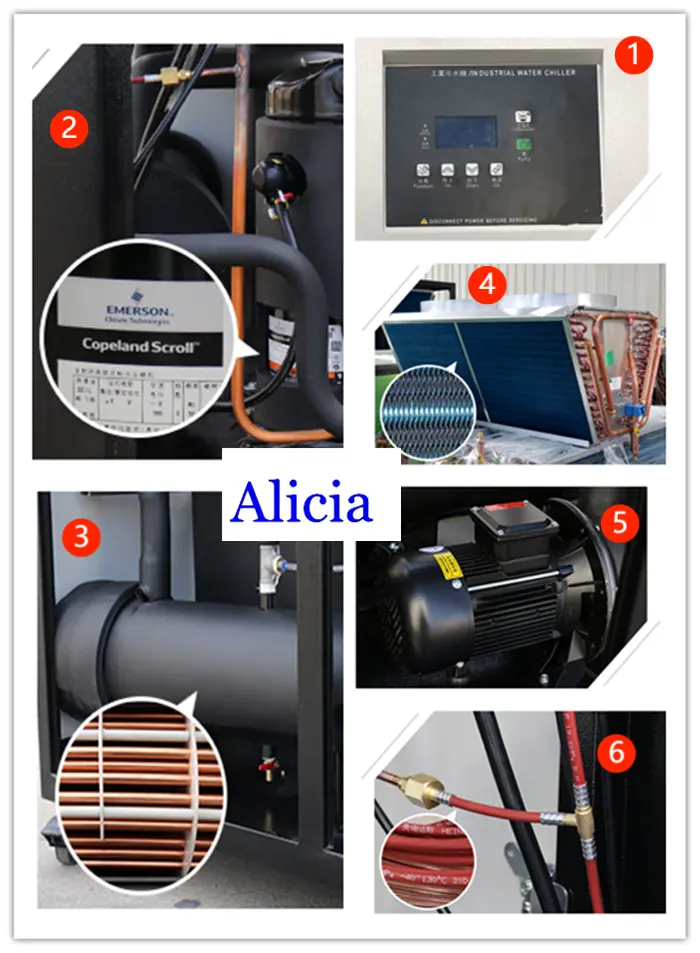
 industrial air cooled chillers

 04   V Type Finned condensers

With high efficient fin type condenser and silent refrigeration fan, no need to equip cooling water, easy to install.


 05  Water Pump

Advanced stainless steel Oakland water pump, with large working range, low noise, reliable performance and no leakage and maintenance-free.


 06   Aviation Hose

Instead of capillary copper tube, it is resistant to high temperature and high pressure, and will not cause refrigerant leakage due to excessive pressure.

 Critical Selection Criteria for Preform Mold Chillers

Choosing the right air-cooled chiller depends on mold size, machine throughput, and environmental conditions. Below are the key factors to consider:

A. Cooling Capacity (kW or BTU/h)

This is the most important factor—undersizing leads to poor cooling, while oversizing wastes energy. Calculate capacity based on:

Mold Cavity Count: More cavities = higher heat load. For example:

A 48-cavity preform mold (common for small bottles) generates ~15–20 kW of heat per cycle.

A 96-cavity mold (high-volume production) generates ~30–40 kW.

Injection Machine Size: Larger machines (e.g., 200-ton vs. 100-ton clamping force) inject more resin, increasing heat load.

Cycle Time: Faster cycles (e.g., 12 seconds vs. 18 seconds) require higher cooling capacity to remove heat more quickly.

Safety Margin: Add 15–20% to the calculated load to account for ambient heat gain (e.g., warm factory air) or mold fouling (resin buildup in cooling channels).

B. Coolant Temperature Range

Preform molds require coolant temperatures of 10–20°C:

Lower temperatures (10–15°C) for thin-walled preforms (e.g., water bottle preforms) to prevent warping.

Slightly higher temperatures (15–20°C) for thick-walled preforms (e.g., detergent bottle preforms) to avoid excessive shrinkage.

Ensure the chiller can maintain this range consistently—even in hot ambient conditions (e.g., 40°C factory air).

C. Flow Rate (L/min or GPM)

The chiller’s pump must deliver enough coolant to fill the mold’s cooling channels and remove heat quickly. Flow rate depends on:

Mold Cooling Channel Size: Smaller channels (3–6mm diameter, common in preform molds) require higher pressure (3–5 bar) to ensure full flow (avoid "dead zones" where coolant stagnates, causing hot spots).

Cavity Count: A 96-cavity mold needs 2x the flow rate of a 48-cavity mold. Aim for a flow rate of ~0.5–1 L/min per cavity.

D. Compressor Type

Choose between scroll compressors (ideal for most preform applications) and screw compressors (for high-capacity needs):

Scroll Compressors: Quiet, efficient, and reliable for 15–50 kW cooling capacity (48–96 cavity molds). They handle variable loads well (e.g., when switching between mold sizes).

Screw Compressors: For 50+ kW capacity (128+ cavity molds or multiple machines on one chiller). They offer higher airflow and are better for continuous, high-load operation.

E. Controls & Connectivity

Look for chillers with:

PLC Integration: Syncs with the injection molding machine’s PLC (programmable logic controller) to adjust cooling based on cycle phase (e.g., increase flow during injection, reduce during demolding).

Digital Temperature Display & Alarms: Monitors coolant temperature in real time and alerts operators to issues (e.g., low coolant level, high discharge pressure) to prevent mold damage.

Remote Monitoring: Some models offer Wi-Fi/BMS (Building Management System) connectivity to track performance and schedule maintenance remotely—critical for 24/7 plants.

F. Glycol Compatibility

If the facility is in a cold climate (ambient temperatures below 0°C) or the chiller is installed outdoors, use a glycol-water mixture (30–50% propylene glycol) to prevent freezing. Ensure the chiller’s pump and heat exchanger are compatible with glycol (e.g., stainless steel or brass components—glycol can corrode aluminum).

Example Application: High-Volume Water Bottle Preform Production
A typical water bottle preform plant uses a 96-cavity mold on a 200-ton injection machine, with a cycle time of 12 seconds (5 cycles per minute = 28,800 preforms per day). To cool this mold:
Cooling Capacity: 35–40 kW (to handle heat from 96 cavities and fast cycles).
Coolant Temperature: 12–15°C (to prevent warping in thin-walled preforms).
Flow Rate: 48–60 L/min (0.5–0.6 L/min per cavity) at 4 bar pressure.
Chiller Type: A 40 kW air-cooled scroll chiller with variable-speed compressor and PLC integration (syncs with the injection machine).
This setup ensures consistent preform quality, 24/7 operation, and minimal energy costs.
Conclusion
Industrial air-cooled chillers are essential for preform mold cooling—they ensure precise temperature control, fast cycle times, and long mold life. By selecting a chiller based on cooling capacity, flow rate, and compatibility with preform molds, manufacturers can maximize production efficiency and avoid costly defects. Their air-cooled design also makes them ideal for facilities where water is scarce or floor space is limited—critical for high-volume PET preform production.
Send your message to us
please select your country
  • Afghanistan
  • Aland Islands
  • Albania
  • Algeria
  • American Samoa
  • Andorra
  • Angola
  • Anguilla
  • Antigua and Barbuda
  • Argentina
  • Armenia
  • Aruba
  • Australia
  • Austria
  • Azerbaijan
  • Bahamas
  • Bahrain
  • Bangladesh
  • Barbados
  • Belarus
  • Belgium
  • Belize
  • Benin
  • Bermuda
  • Bhutan
  • Bolivia
  • Bosnia and Herzegovina
  • Botswana
  • Bouvet Island
  • Brazil
  • British Indian Ocean Territory
  • British Virgin Islands
  • Brunei Darussalam
  • Bulgaria
  • Burkina Faso
  • Burundi
  • Cambodia
  • Cameroon
  • Canada
  • Cape Verde
  • Caribbean Netherlands
  • Cayman Islands
  • Central African Republic
  • Chad
  • Chile
  • Christmas Island
  • Cocos Islands
  • Colombia
  • Comoros
  • Congo
  • Cook Islands
  • Costa Rica
  • Cote D'ivoire
  • Cuba
  • Curaçao
  • Cyprus
  • Czech Republic
  • Democratic Republic of the Congo
  • Denmark
  • Djibouti
  • Dominica
  • Ecuador
  • Egypt
  • El Salvador
  • Equatorial Guinea
  • Eritrea
  • Estonia
  • Ethiopia
  • Falkland Islands
  • Faroe Islands
  • Fiji
  • Finland
  • France
  • French Guiana
  • French Polynesia
  • French Southern Territories
  • Gabon
  • Gambia
  • Georgia
  • Germany
  • Ghana
  • Gibraltar
  • Greece
  • Greenland
  • Grenada
  • Guadeloupe
  • Guam
  • Guatemala
  • Guernsey
  • Guinea
  • Guinea-Bissau
  • Guyana
  • Haiti
  • Heard Island and Mcdonald Islands
  • Honduras
  • Hong Kong, China
  • Hungary
  • Iceland
  • India
  • Indonesia
  • Iran
  • Iraq
  • Ireland
  • Isle of Man
  • Israel
  • Italy
  • Jamaica
  • Japan
  • Jordan
  • Kazakhstan
  • Kenya
  • Kiribati
  • Korea
  • Kosovo
  • Kuwait
  • Kyrgyzstan
  • Laos
  • Latvia
  • Lebanon
  • Lesotho
  • Liberia
  • Liechtenstein
  • Lithuania
  • Luxembourg
  • Macedonia
  • Madagascar
  • Malawi
  • Malaysia
  • Maldives
  • Mali
  • Malta
  • Marshall Islands
  • Martinique
  • Mauritania
  • Mauritius
  • Mayotte
  • Mexico
  • Micronesia
  • Moldova
  • Monaco
  • Montenegro
  • Montserrat
  • Morocco
  • Mozambique
  • Myanmar
  • Namibia
  • Nauru
  • Nepal
  • Netherlands
  • Netherlands Antilles
  • New Caledonia
  • New Zealand
  • Nicaragua
  • Niger
  • Nigeria
  • Niue
  • Norfolk Island
  • Northern Mariana Islands
  • Norway
  • Oman
  • Pakistan
  • Palau
  • Palestine
  • Panama
  • Papua New Guinea
  • Paraguay
  • Peru
  • Philippines
  • Pitcairn Islands
  • Poland
  • Portugal
  • Puerto Rico
  • Qatar
  • Reunion
  • Romania
  • Russia
  • Rwanda
  • Saint Barthélemy
  • Saint Helena
  • Saint Kitts and Nevis
  • Saint Lucia
  • Saint Martin
  • Saint Pierre and Miquelon
  • Saint Vincent and the Grenadines
  • San Marino
  • Sao Tome and Principe
  • Saudi Arabia
  • Senegal
  • Serbia
  • Seychelles
  • Sierra Leone
  • Singapore
  • Sint Maarten
  • Slovakia
  • Slovenia
  • Solomon Islands
  • Somalia
  • South Africa
  • South Georgia and The South Sandwich Islands
  • Spain
  • Sri Lanka
  • State of Libya
  • Sudan
  • Suriname
  • Svalbard and Jan Mayen
  • Swaziland
  • Sweden
  • Switzerland
  • Syrian Arab Republic
  • Tajikistan
  • Tanzania
  • Thailand
  • The Republic of Croatia
  • Togo
  • Tokelau
  • Tonga
  • Trinidad and Tobago
  • Tunisia
  • Turkey
  • Turkmenistan
  • Turks and Caicos Islands
  • Tuvalu
  • Uganda
  • Ukraine
  • United Arab Emirates
  • United Kingdom
  • United States
  • United States Minor Outlying Islands
  • Uruguay
  • US Virgin Islands
  • Uzbekistan
  • Vanuatu
  • Vatican City State
  • Venezuela
  • Vietnam
  • Wallis and Futuna Islands
  • Western Sahara
  • Western Samoa
  • Yemen
  • Zambia
  • Zimbabwe
ver_code
pop_close
pop_main
Stay In The Know
Enter your email to hear from us about Product list, Latest Products and Customer application examples!