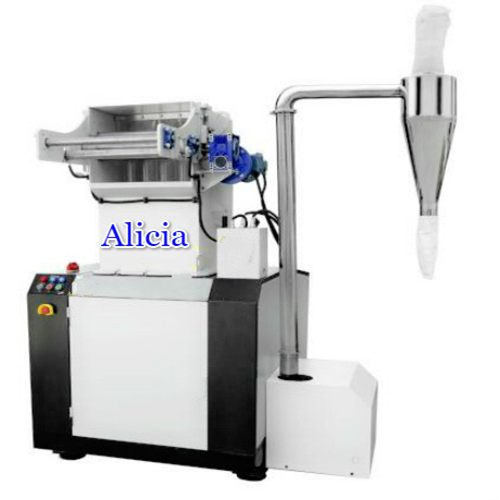
Detailed Introduction to Plastic Pet PP Film Sheet Roll Crushing Machine
1. Overview
The Plastic Pet PP Film Sheet Roll Crushing Machine is a specialized industrial equipment designed for the efficient reduction of plastic materials such as Polyethylene Terephthalate (PET), Polypropylene (PP) films, sheets, and rolls into uniform, small-sized particles. As a critical link in the plastic recycling and processing industry, this machine addresses the challenges of handling large, flexible, or bulky plastic forms, converting them into manageable feedstock for subsequent processes like extrusion, injection molding, or pelletizing.
2. Core Functions
2.1 Efficient Crushing of Diverse Plastic Forms
The machine excels in processing a wide range of plastic inputs, including:
PET Materials: PET films (used in packaging, labels), PET sheets (for blister packaging, trays), and PET rolls (large-format industrial films).
PP Materials: PP films (agricultural films, food packaging films), PP sheets (corrugated sheets, plastic containers), and PP rolls (heavy-duty industrial rolls).
Other Compatible Plastics: It can also handle low-density polyethylene (LDPE) and high-density polyethylene (HDPE) films/sheets with minor adjustments to crushing parameters.
2.2 Particle Size Customization
Equipped with adjustable cutting components (e.g., rotor blades, screen mesh), the machine allows users to customize the output particle size according to specific processing needs. Common particle sizes range from 3mm to 20mm, ensuring compatibility with different downstream equipment. For example, finer particles (3-8mm) are suitable for injection molding, while coarser particles (10-20mm) work well for extrusion processes.
2.3 Debris and Impurity Removal (Optional)
High-end models come with integrated separation systems, such as air suction devices or magnetic separators. These features effectively remove light impurities (e.g., paper, dust) and metal contaminants (e.g., staples, metal fragments) from the crushed plastic particles, improving the purity of the final product and protecting downstream processing equipment.
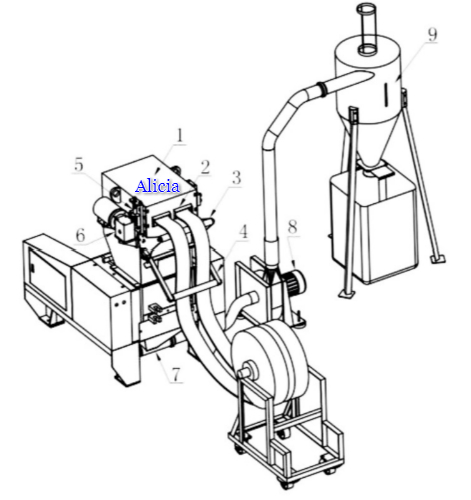
Structure Diagram1.Traction Feeding Hopper2. Feeding Inlet3. Conveying Barrel4.Anti Shortage Device5. Compression Adjusting Spring6. Reducer7.Receiver8.Loading Blower9. Hopper Tank
3. Working Principle
The PET/PP Film/Sheet Roll Crusher operates in a simple yet efficient four-step cycle:
Step 1: Feeding
Plastic material (film, sheet, or roll) is fed into the machine through a large hopper. For rolls or long sheets, a manual or automatic unwinding device is available to ensure continuous and uniform feeding and prevent material blockage.
Step 2: Crushing
Inside the machine's crushing chamber, a high-speed rotor with multiple blades rotates, cutting the plastic material into small pieces. The blades are made of high-quality alloy steel (such as Cr12MoV), which is hard and wear-resistant, ensuring they remain sharp for a long time. The inner wall of the crushing chamber features a "reverse cutting" structure that works in conjunction with the rotor blades to improve crushing efficiency and reduce energy consumption.
Step 3: Screening
The crushed plastic particles pass through a screen at the bottom of the crushing chamber. Only particles that meet the required size pass through the screen, while larger particles remain in the crushing chamber for further crushing until they reach the desired size. This ensures uniform particle size and consistent quality.
Step 4: Discharge and Separation (Optional)
Qualified granules are discharged from the machine via a conveyor or suction system. If the machine is equipped with a dust removal system, light impurities are removed by suction, while metallic impurities are captured by a magnetic separator during discharge. The resulting clean granules are collected in a storage silo or directly conveyed to downstream processing equipment.
4. Application Fields
The Plastic Pet PP Film Sheet Roll Crushing Machine is widely used in the following industries:
4.1 Plastic Recycling Industry
It is a core equipment in plastic recycling plants, processing waste plastic films (e.g., agricultural mulch films, packaging films), waste PET bottles (after flattening into sheets), and waste PP containers (after crushing into sheets) into recycled plastic particles. These particles can be reprocessed into new plastic products, such as plastic bags, flower pots, and plastic pipes.
4.2 Plastic Product Manufacturing Industry
Plastic product manufacturers use the machine to crush production scrap (e.g., leftover film edges, defective plastic sheets) into particles, which are then mixed with new plastic materials for reprocessing. This reduces material waste and lowers production costs. For example, a plastic film manufacturer can crush the leftover edges of film rolls and reuse the particles to produce new films.
4.3 Waste Management Industry
Waste management centers use the machine to process large volumes of plastic waste collected from households and businesses. By crushing the plastic waste into small particles, it reduces the volume of waste, making transportation and storage easier. The crushed particles can then be sold to recycling plants, creating additional revenue for the waste management center.
4.4 Other Industries
It is also used in industries such as agriculture (processing waste agricultural films), food packaging (processing waste packaging films), and automotive (processing waste plastic parts into sheets for crushing).
Product Advantages
- Efficient Crushing: Designed for PET films, plastic sheets, and industrial plastic waste processing.
- Low-Noise Operation: Features soundproofing technology for a quieter working environment.
- Automated Feeding: Includes an auto feeder for continuous and high-speed operation.
- Durable & Reliable: Built with high-strength steel blades and reinforced structure for long-term use.
Use Scenarios
Integration in PET Packaging and Labeling Waste Management
Within the PET packaging and labeling industry, effective waste reduction is a strategic imperative to maximize material utilization and minimize environmental footprint. This pet roll film crusher serves a critical role by processing residual PET film rolls and sheets generated during packaging runs. Its ability to shred varying input materials and discharge chips via the integrated blower and silo hopper facilitates smooth incorporation into recycling workflows. The machine’s design addresses compliance with waste handling regulations by converting scrap into reusable feedstock, seamlessly connecting upstream extrusion or labeling machines with recycling downstream, thus optimizing the entire production chain.
Adoption in Thermoforming and Extrusion Line Scrap Processing
In extrusion and thermoforming operations, edge trim waste and film rolls represent significant material loss without effective reprocessing. This plastic recycling machine supplier solution enables the conversion of such scraps into uniform particles suitable for pelletizing and refeeding into production. The unit’s dual feed ports accommodate diverse inputs, while its automatic feeding and cooling systems ensure continuous and stable operation, even in high-volume contexts. Its incorporation reduces manual handling risks, improves process consistency, and aligns with lean manufacturing goals. Consequently, it supports sustainable production lines by enhancing raw material recovery and operational accountability.
Why Choose Us?
- Wide Range of Products: We offer a variety of high-quality plastic auxiliary machines including shredders, crushers, mixers, and chillers.
- Extensive Network: With over 100 qualified factories, we source only from trusted manufacturers.
- Expertise: Over 10 years of experience in the plastic machinery industry.
- One-Stop Service: We provide comprehensive services, including factory audits, quality inspections, and logistics coordination.
- Dedicated Customer Support: We are committed to providing efficient and responsive customer service throughout the entire process.
FAQ
What types of materials can the PET roll film plastic sheet crusher process?
Our plastic sheet crusher is designed to handle PET film rolls, plastic sheets, extrusion edge stock, and thermoforming waste. This flexibility allows efficient recycling and processing for various industrial plastic materials with consistent, uniform particle output.
Can the plastic crusher be customized for different production needs?
Yes, we offer customization options such as dual feed ports—one for PET sheets or film, the other for PET bottles or additional waste—to enhance versatility. Features like an automatic feeding system and cooling mechanisms can also be configured based on your operational requirements.
Do you provide installation and after-sales support for the plastic recycling machine?
We assist clients with technical guidance during installation and offer ongoing after-sales support to ensure smooth operation. Our team is available to help with troubleshooting and maintenance advice to maximize the longevity and reliability of your plastic recycling machine supplier equipment.
How is the shredded material handled and collected in this plastic sheet crusher?
Our PET roll film crusher includes an integrated blower and silo hopper that convey shredded chips directly to a collection point. This reduces manual handling and improves workflow efficiency in your recycling or production line environment, ensuring stable operation during high-capacity use.


