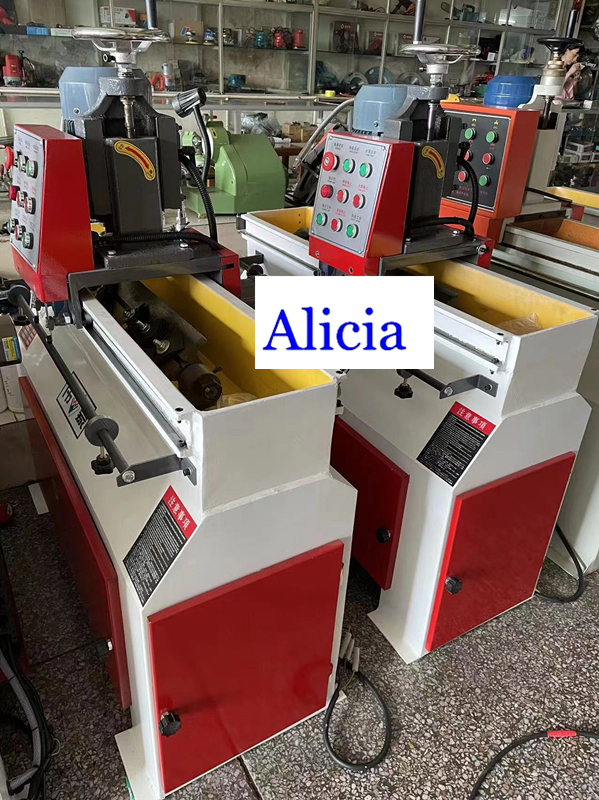
Operating Principle of crusher blades sharpening machines
This shredder blade grinder is a gantry-style, fully automatic, adjustable-speed sharpener. It utilizes a rolling linear guide drive and cooling water sprayed from the center of the grinding wheel for effective cooling. Both the grinding head movement and grinding wheel speed are controlled by an imported frequency converter, allowing for variably adjustable speeds within a specified range. The grinding wheel automatically feeds the blade, significantly reducing sharpening costs. Suitable for sharpening a variety of straight-faced blades, it is an ideal sharpening device for industries such as printing, papermaking, woodworking, plastic leather, and board manufacturing.
Structural Components of crusher blades sharpening machines
Grinding Components: These are the core components of the grinder and typically include the grinding disc and grinding wheel. Their material and grit size significantly influence the grinding effect. For example, for harder blade materials, grinding discs containing abrasives such as diamond or cubic boron nitride can be used.
Blade Clamp: This secures the blade to be sharpened, ensuring a stable position and angle during the grinding process, ensuring precise and consistent grinding. Drive System: Typically composed of a motor and transmission, it provides rotational power to the grinding element. The motor's speed and transmission ratio can be adjusted to control the grinding speed and force.
Feed System: Some grinders are equipped with a feed system that automatically feeds the blade relative to the grinding element, ensuring a more uniform and efficient grinding process.
Control System: This controls grinder operating parameters, such as grinding time, speed, and feed rate, to ensure the desired grinding results and allows for automated operation.
Cooling System: Some blade sharpeners feature a cooling water system, which sprays cooling water from the center of the grinding wheel. This effectively cools the blade, prevents burns, and conserves coolant.
Technical Parameters
Max. grinding stroke:780mm
Motor power:60W
Max grinding length:700mm
Grinding whee speed:2830r/min
Grinding tilting angle:0-90
Grinding motor power:2.2kw
Machine size 750x 1200X 1400
Product Description
Dedicated Maintenance Equipment for Cutter-Blades
This professional knife sharpening machine is specifically designed for service technicians, equipment maintenance teams and recycling line operators responsible for servicing the cutter-blades within crusher and granulator systems. These end-users demand a reliable solution that addresses the wear of stationary and rotary blades used in plastic-waste size-reduction systems. The blade sharpening machine helps restore cutter geometry, maintain straightness and prolong service life, enabling smoother production flows with fewer interruptions. For lines where large blades feed into a granulator, this machine ensures the input cutter-set remains optimal and consistent.
Core Technical Features & Parameters
The machine incorporates a rigid bed, precision linear slide and grinding wheel assembly, often combined with magnetic suction or clamping to hold the blade firmly during grinding. According to available equipment references, features may include: blade support length up to 700 mm, adjustable stroke, angle-adjustment from 0° to 90°, grinding wheel speeds around 2,800 rpm or more, and motor power from ~2.2 kW (for smaller models) upward. Cooling spray-nozzles may be integrated to protect blade temper during grinding. These parameters enable this sharpening machine to service large cutter-sets used in crushers or granulators—supporting maintenance of size-reduction equipment. The precision of this blade sharpening machine contributes directly to cutter-life extension and consistent cutting performance.
Application Context & Value-Contribution
In plastics recycling plants, film and sheet processing facilities, or injection-moulding trimming lines, cutter-blade wear is a common challenge—blunt or mis-aligned blades increase fines, produce uneven flakes and lead to higher energy consumption. This blade sharpening machine addresses those issues by enabling regular refurbishment of knives before they reach critical wear levels. For operators of plastic-reduction lines, adopting this sharpening machine reduces downtime, lowers spare-blade expenditure and enhances throughput. When integrated as part of a maintenance strategy, this machine ensures blades keep the correct geometry, which in turn supports downstream performance of crushers and granulators, with resulting improvements in efficiency and product quality.
Product Advantages
Stable Mechanical Framework for Precise Blade Restoration
One key advantage is the machine’s solid structural design. A heavy-duty frame combined with a magnetic or clamp-type fixture keeps the blade immobile and straight during grinding, virtually eliminating distortion. For service teams using a blade sharpening machine, this stability means consistent results across cycles, which leads to improved cutter performance in the downstream size-reduction line. The result: fewer blade failures, improved productivity and more predictable maintenance scheduling with the professional knife sharpening machine.
Modular Service Components & Adaptable Layout
A second advantage lies in its modular build. Grinding wheel assemblies, angle adjustment fixtures, cooling spray units and blade-fixtures are designed for quick replacement or adaptation. This modular architecture gives maintenance managers flexibility—they can service blades of different lengths, replace wheel assemblies without major downtime, and tailor the sharpening machine’s configuration to blade-type variation. Efficient adaptability thus becomes a differentiator when compared to less specialised alternatives.
Operational Efficiency and Cost-Effectiveness Over Lifecycle
The third advantage emphasises lifecycle cost savings. By returning cutter-blades to near-original geometry and sharpness, this machine ensures that the performance of upstream size-reduction equipment remains consistent. Sharp blades mean less load on the rotor, fewer oversized fragments, more uniform feed to granulators and less energy wasted. Over time, this extends blade service life, reduces replacements and drives down maintenance costs. For facilities managing large volumes of plastic waste, the sharpening machine becomes a strategic investment rather than a reactive fix.
Use Scenarios
Maintenance Supervisor at a Film Recycling Plant
A maintenance supervisor is responsible for a film-shredding line followed by a granulator. The supervisor uses the blade sharpening machine each week to restore the stationary and rotary knives before they become worn. By doing so, the team prevents quality issues in the pelletising or granulating steps downstream. The knife sharpening machine supports their preventive-maintenance schedule, and because the blades are in optimal condition, the recycling line achieves steady throughput with minimal unplanned stops.
Field Service Engineer for Equipment Supplier
A service engineer working for an equipment provider travels to customer sites to perform blade maintenance for crushers and granulators. They deploy the sharpening machine on-site, clamp the customer’s blades, set the grinding stroke and angle, and restore edge condition in one visit. With the professional knife sharpening machine on hand, they reduce turnaround time, restore optimal cutter function for the client’s size-reduction equipment and strengthen the supplier’s maintenance offering.
In-house Quality Engineer at a Pelletiser Manufacturer
A quality engineer at a manufacturer of pelletising lines uses this sharpening machine in their in-house fabrication lab. Before blades are shipped to clients for the pelletiser or granulator systems, they are sharpened and verified. The blade sharpening machine ensures the delivered cutter-sets meet the manufacturer’s tolerance for straightness and edge geometry. This internal use supports the brand’s reliability, less field rework and greater customer satisfaction.
About Us
Alicia Import & Export Trade Co., Ltd., based in Changsha City, Hunan Province, China, specialises in the export of auxiliary machinery for plastics processing and recycling systems. We collaborate with a network of qualified factories producing shredders, mixers, dehumidifiers, chiller systems, pelletising and granulating lines, and related support equipment such as blade-sharpening machines. Our clients include plastics processors, recycling plants, extrusion and injection-moulding operations across North America, South America, Africa, Oceania and Europe. We offer sourcing, factory audit coordination, export logistics, and quality assurance services to build long-term supply-chain partnerships.
We invite you to request specification details, compare model options and arrange shipping!
FAQ
1.What blade size range can this machine handle?
The machine supports large cutter-blades used in size-reduction systems; typical specifications allow blade lengths up to ~700 mm and thicknesses per model range as determined by the supplier.
2.What is the warranty and after-sales support structure?
Warranty, spare-parts provision and remote or onsite service depend on the brand. Typically, service covers the mechanical drive and grinding wheel assembly, with recommended maintenance schedules.
3.Is it compatible with blades from different crusher or granulator brands?
Yes, provided the blade dimensions (length, thickness, mounting/shaping) fall within the machine’s clamp-fixture and grinding capacity. It is advisable to confirm compatibility prior to purchase.
4.What is the expected lead time for delivery after placing an order?
Lead time depends on configuration, availability and logistics; please consult the supplier for a current production schedule.
5.How are settings and adjustments (stroke, angle, feed) managed and secured?
Settings are managed via local controls: stroke adjustment, angle setting and feed rate. It is recommended to document adjustment parameters and restrict access if used in a multi-user maintenance environment to maintain calibration and safety.


