Marine Chiller, Titanium Seawater Chiller, Sea Water Cooled Chiller
A Titanium Seawater Chiller is a kind of refrigeration equipment that uses titanium as the main heat - exchange material and is suitable for seawater or other corrosive liquid environments. Here is a detailed introduction:
Titanium Seawater Chiller Working Principle
It works based on the vapor - compression refrigeration cycle. The compressor compresses the refrigerant gas, raising its pressure and temperature. The high - temperature and high - pressure refrigerant gas then enters the titanium heat exchanger (evaporator or condenser). In the evaporator, the refrigerant absorbs heat from the seawater, evaporates and turns into gas, thus cooling the seawater. The gas refrigerant is then compressed again by the compressor and enters the condenser, where it releases heat to the outside air or other cooling media and condenses back into a liquid. This cycle repeats to achieve continuous cooling of seawater.
Titanium Seawater Chiller Structural Features
Titanium Heat Exchanger: This is the core component. Titanium has excellent corrosion - resistance, which can effectively resist the erosion of seawater, ensuring the service life and reliability of the chiller. For example, the titanium tube evaporator in some models can maintain good heat - transfer performance in seawater for a long time.
Compressor: Common types include scroll compressors and reciprocating compressors. Scroll compressors are known for their high efficiency, low noise, and stable operation, while reciprocating compressors are suitable for some applications with specific requirements.
Control System: It usually includes a temperature controller, pressure switch, and other components. The temperature controller can precisely control the temperature of the chilled water, and the pressure switch can protect the system from overpressure or underpressure.
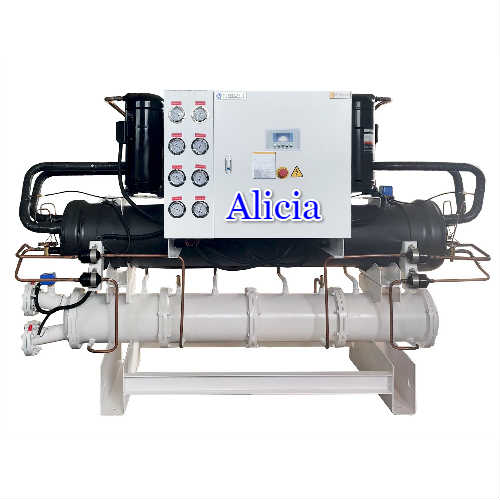 Heat ExchangerShell and tube evaporator: Titanium materialShell and tube condenser: stainless steel 316L material,others as requirementSchneider Electric for seawater cooled scroll chillerPPR electric control box, anti-corrosive from seawaterFrench Schneider, LS electric accessories.Well-designed and reasonable Pipelines-ensures power supply and saves energy.Brand Compressor for seawater cooled scroll chillerBuilt with world-market-leading component brands as COPELAND, DANFOSS scroll compressors.BITZER, AND HANDBELL brand screw compressor also available as required
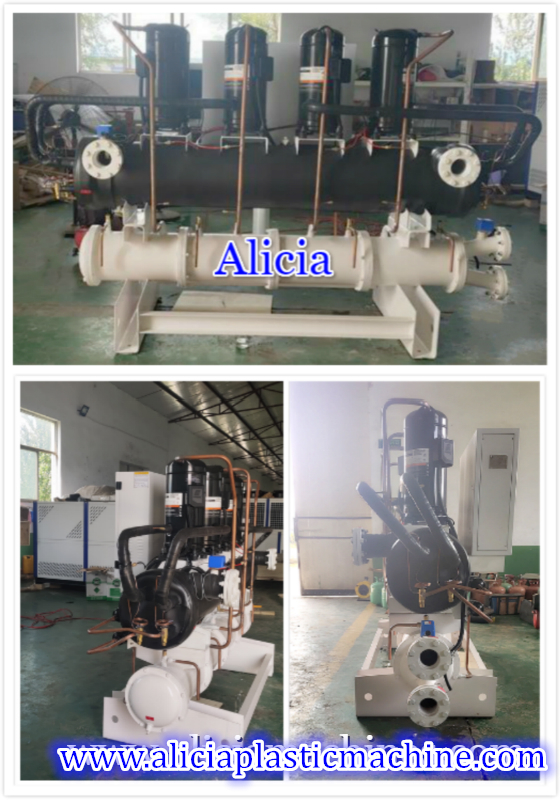 Pump for seawater cooled scroll chillerWater pump for seawater cooling, normally use stainless steel 316 material to keep corrosive of seawater, with high lift, large flow, low energy consumption, smooth and reliable operation, high efficiency and lower fault, low vibration noise, long life, and other advantages to ensure that water quality away from corrosion.Complete water cooling system for seawater cooled chillerChiller will be installed on the fishing ship, the cooling water for condenser comes from the sea directly and discharge directly, with good cooling performance, so does not need a cooling tower. Only need items below1- SeaWater cooled chiller2- Cooling pumps3- Chilled Water pumps4- Fishtanks
Titanium Seawater Chiller Advantages
Corrosion Resistance: Titanium has strong resistance to seawater corrosion, salt - spray corrosion, and crevice corrosion, which is crucial for equipment operating in marine environments. This property greatly extends the service life of the chiller and reduces maintenance costs.
High Heat - Transfer Efficiency: Titanium has good thermal conductivity, and the well - designed titanium heat exchanger can achieve efficient heat transfer, ensuring the cooling effect of the chiller.
Lightweight and Strong: Compared with some other metals, titanium has a high strength - to - weight ratio, making the chiller relatively lightweight while maintaining structural strength.
Titanium Seawater Chiller Applications
Marine Aquaculture: Used to cool seawater in aquaculture ponds or tanks to provide a suitable water temperature environment for the growth of fish, shrimp, and other marine organisms.
Marine Engineering: Such as cooling systems for ships, offshore platforms, etc. It can cool the engines, generators, and other equipment on board to ensure their normal operation.
Desalination Plants: In seawater desalination processes, it is used to cool related equipment, helping to improve the efficiency and stability of desalination systems.


