


FRP Round Type Counter Flow Induced Draft Cooling Tower
An induced draft cooling tower is a type of mechanical draft cooling tower that uses fans to extract air for ventilation and cooling. The following is a detailed description of its operation:
Working Principle: A water pump delivers circulating water to the top of the cooling tower, where it is atomized or evenly distributed into droplets or a film through a spray device or water distribution system. The fan at the top of the tower operates, drawing outside air into the tower. The air and falling water come into contact with each other in the packing layer or the inner space of the tower, exchanging heat. The heat from the water is transferred to the air, and the cooled water is collected in a sump for recycling. The air, having absorbed the heat, is then discharged from the top of the tower.
Structural Components: It primarily consists of a fan, tower body, packing, a water collector, and louvers. The fan is typically an axial flow fan, mounted at the top of the tower. The tower body is often constructed of fiberglass, steel, or concrete. The packing increases the contact area between water and air, improving heat exchange efficiency. The water collector reduces water droplets carried out of the tower by the airflow, minimizing water loss. Louvers installed at the air inlet improve airflow conditions and prevent splashing and the ingress of debris. Types: Based on the direction of air and water flow, cooling towers can be divided into induced draft counterflow cooling towers and induced draft crossflow cooling towers. In the former, air and water flow in countercurrent, resulting in excellent heat exchange performance; in the latter, air enters the tower horizontally to exchange heat with water, resulting in a compact size, simple structure, and simple water distribution.
Features: induced draft cooling towers create a negative pressure inside the tower, which promotes water evaporation, resulting in excellent cooling performance, stable operation, a small footprint, and low capital investment. However, due to the requirement for continuous fan operation, operating costs are relatively high.
Applications: They are widely used in industries such as power, chemical, steel, and papermaking to cool various process fluids in production processes. They are also commonly used in central air conditioning systems in urban commercial buildings to cool chilled water.

Introduction for countflow cooling tower:
The process flow direction of the counterflow cooling tower is opposite to the air flow direction. The filling medium is installed horizontally under the hot water distribution basin. When the air passes through the filling, it absorbs the heat of the water flowing down from the filling, thereby performing the cooling process.
The fans usually located above the water distribution nozzle, pulls air through the filling medium. The cooled process water will be discharged from the packing to a cold water basin at the bottom of the tower.
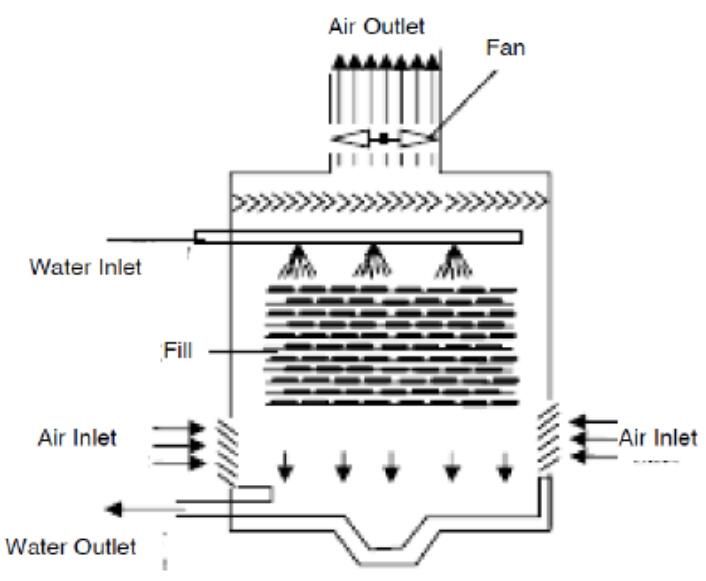
Working principle for cooling tower
A cooling tower is designed to remove heat from a building or facility by spraying water down through the tower to exchange heat into the inside of the building. Air comes in from the sides of the tower and passes through the falling water. As the air passes through the water, heat is exchanged and some of the water evaporates. This heat and evaporated water flow out the top of the tower in the form of a fine cloud-like mist. The cooled water is collected at the bottom of the tower and pumped back into the plant or building for reuse.
Applications for cooling tower
Cooling towers are primarily used for heating, ventilation, and air conditioning (HVAC) and industrial purposes. Cooling towers provide a cost-effective and energy efficient operation of systems in need of cooling. HVAC systems are used typically in large office buildings, schools, and hospitals. Industrial cooling towers are larger than HVAC systems and are used to remove heat absorbed in the circulating cooling water systems used in power plants, petroleum refineries, petrochemical plants, natural gas processing plants, food processing plants, and other industrial facilities.


