By Alicia Import and Export Trade Co., Ltd | 05 August 2025 | 0 Comments
Differences between a single-shaft shredder & a double-shaft shredder
What's the difference between a single-shaft shredder and a double-shaft shredder?
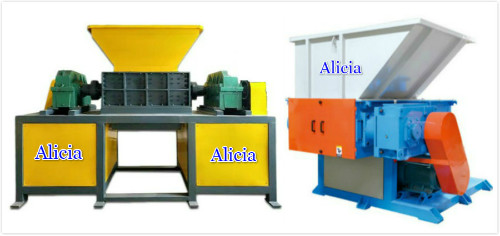
Single-shaft and double-shaft shredders are two common types of industrial shredder equipment. They differ significantly in their structure, operating principle, applicable materials, and performance. The following is a detailed comparison of the two from multiple perspectives:
I. Structure and Operating Principle
1. Single-Shaft Shredder
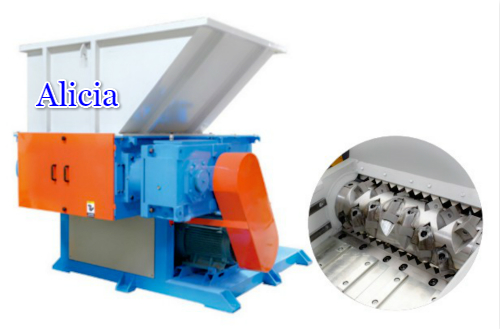
Structure: There is only one main shaft, on which are mounted a spirally arranged array of blades (or cutterheads), which cooperate with fixed blades (stationary blades) inside the housing to form a shearing mechanism.
Operating Principle: After entering the crushing chamber, the material is crushed by the shearing and tearing forces between the high-speed rotating main shaft blades and the stationary blades. The crushed material is then discharged through a screen (the screen aperture determines the discharge size).
2. Double-Shaft Shredder
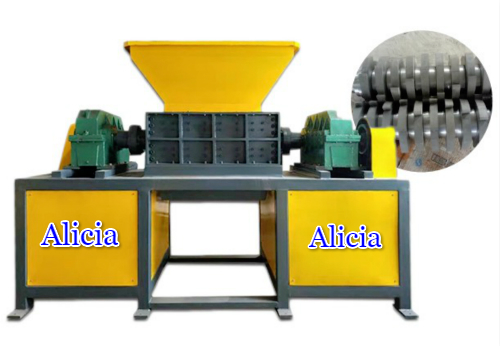
Structure: It consists of two parallel, counter-rotating shafts, each equipped with staggered blades (teeth). The blades on the two shafts mesh with each other (with an adjustable gap). Working principle: The material falls between the two shafts and is crushed by the extrusion force, shear force and tearing force generated by the counter-rotating shafts. No screen is required, and the crushed material is discharged directly from under the two shafts.
II、Core Difference Comparison
| Comparison Dimensions | Single-Shaft Shredder | Dual-Shaft Shredder |
| Crushing Force | Mainly relies on the shearing action of a single-shaft blade and a fixed blade, resulting in a relatively simple force. | The counter-rotating shafts create a combined force (compression + shearing + tearing), providing enhanced crushing force. |
| Applicable Materials | Soft or medium-hard materials: plastic film, paper, cloth, wood scraps, etc. | Hard or tough materials: metal scrap, rubber tires, thick plastic blocks, construction waste, cables, etc. |
| Output Particle Size | Relatively uniform (controlled by a screen), enabling finer crushing. | Relatively uneven (without a screen), more suitable for coarse or medium crushing. |
| Processing Efficiency | Medium efficiency for small and medium batch processing. | Higher efficiency for large and continuous batch processing (smoother dual-shaft coordinated feeding). |
| Energy Consumption and Power | Low power (typically 5-30kW), resulting in lower energy consumption. | Large power (typically 15-100kW). (above), high energy consumption |
| Risk of Blockage | Likely blocked by material entanglement or hard blocks (single-axis feed relies on the material's own weight) | Low risk of blockage (two-axis active material gripping, forced feeding) |
| Maintenance Cost | Slower blade wear (softer materials), simple maintenance | Fast blade wear (harder materials), requiring regular shaft clearance adjustment, high maintenance cost |
| Equipment Size | Compact structure, small footprint | Complex structure, larger size, large footprint |
III. Typical Application Scenarios
Single-Shaft Shredder:
Suitable for light industrial waste processing, such as plastic recycling (film, bottles), papermaking waste paper shredding, and textile waste shredding. It is particularly well-suited for applications requiring a fine and uniform output particle size.
Dual-Shaft Shredder:
Suitable for heavy industry or solid waste processing, such as coarse shredding of difficult-to-shred materials such as automobile hulls, metal cans, used tires, large furniture, and electronic waste (such as refrigerators and televisions). It is a core pre-treatment device for waste incineration and resource recovery.
IV. Summary
The choice between a single-shaft or dual-shaft shredder depends primarily on material properties (hardness, toughness), processing capacity, output requirements, and budget:
1. For processing soft, small-batch materials, requiring fine particle size and low energy consumption → Choose a single-shaft shredder;
2. For processing hard, large-batch, or difficult-to-shred materials, prioritizing shredding capacity and efficiency → Choose a dual-shaft shredder.
Claim Boundaries In Industrial Shredder Machine Supplier Content
Versatility in Recycling: The Multi-Voltage AT-600S Shredder
Leave a Reply
Your email address will not be published.Required fields are marked. *