By Alicia Import and Export Trade Co., Ltd | 28 February 2025 | 0 Comments
Application of air cooled & water cooled chiller in extrusion industry
In the extrusion industry for pipes and profiles, precise temperature control is of paramount importance to ensure the quality and performance of the final products. Industrial air-cooled and water-cooled chillers play crucial roles in maintaining the optimal operating conditions, and understanding their differences is key to making the right choice for specific production needs.


The working principle of industrial air-cooled chillers is based on utilizing ambient air to dissipate heat. Comprising a compressor, condenser, evaporator, and expansion valve, these chillers operate as follows. In the extrusion process of pipes and profiles, the hot polymer melt, which is forced through a die to form the desired shape, generates copious amounts of heat. The air-cooled chiller functions by circulating a refrigerant through the evaporator. As the hot process fluid, such as the cooling water used to cool the extrusion die and the extruded product itself, passes over the evaporator coils, the refrigerant absorbs the heat, transitioning into a vapor state. Subsequently, the vaporized refrigerant migrates to the condenser, where it releases the heat to the surrounding air, condensing back into a liquid to recommence the cycle.
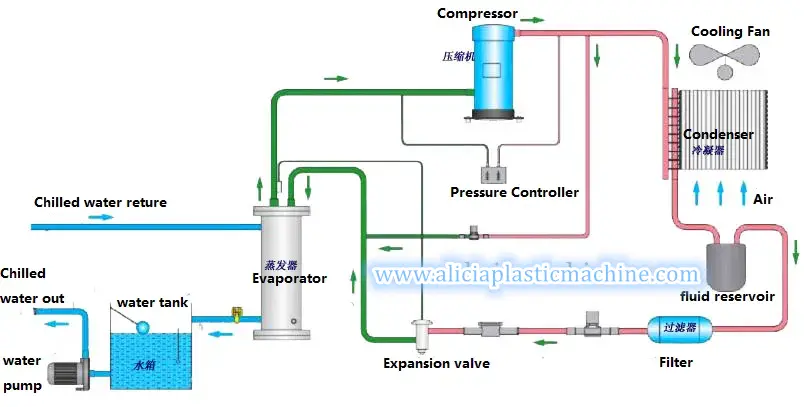
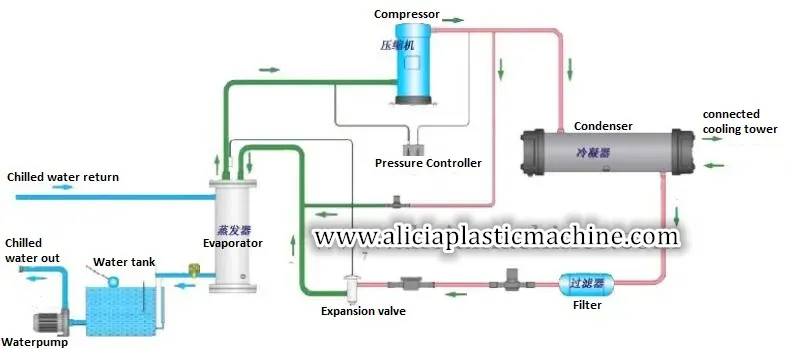
In contrast, industrial water-cooled chillers employ water as the secondary cooling medium. They also consist of the essential components like compressor, condenser, evaporator, and expansion valve. The hot refrigerant gas emerging from the evaporator discharges its heat into the water within the condenser. The warmed water is then pumped to a cooling tower. At the cooling tower, the water is cooled down through evaporation and air circulation before being recirculated back to the chiller. This continuous loop allows for efficient heat dissipation.
When it comes to their applications in the extrusion industry, both types of chillers have proven their worth in different scenarios. For instance, a small to medium-sized plastic extrusion company that specializes in producing decorative plastic profiles for home improvement applications, such as window trims and baseboards, has found great success with an air-cooled chiller. The company operates in a relatively temperate climate region, and the production volume is not extremely high. The air-cooled chiller's simple installation and relatively low maintenance requirements fit well with their setup. It effectively cools the extrusion dies and the newly formed profiles, ensuring that the plastic hardens evenly and retains its shape. Without the proper cooling provided by the air-cooled chiller, the profiles would warp or have inconsistent dimensions, leading to a high rejection rate.
On the other hand, a large industrial facility manufacturing high-precision aluminum pipes for aerospace applications relies on a water-cooled chiller. The extrusion process for these pipes generates an enormous amount of heat due to the high melting point of aluminum and the demanding production standards. The water-cooled chiller's ability to handle massive heat loads with precision is crucial. The cooling tower works in tandem with the chiller to constantly recycle and cool the water, maintaining a stable temperature environment. This precision cooling allows the aluminum pipes to meet the strict tolerances required in the aerospace industry. Any deviation in temperature could result in pipes with suboptimal mechanical properties, compromising the safety and performance of the final products.
Another example is a mid-sized PVC pipe extrusion factory located in a hot and humid climate zone. Initially, they opted for an air-cooled chiller, but as their production expanded, they faced challenges. The ambient air temperature and humidity during the summer months affected the chiller's efficiency, leading to inconsistent cooling of the PVC pipes. After switching to a water-cooled chiller, they noticed a significant improvement. The water-cooled chiller was able to overcome the climatic challenges, providing consistent cooling regardless of the outside conditions. This led to a reduction in product defects and an increase in overall production efficiency.
In conclusion, both industrial air-cooled and water-cooled chillers have their unique applications in the extrusion industry for pipes and profiles. Manufacturers need to meticulously consider factors such as production scale, available space, ambient conditions, and the required level of temperature control when choosing between the two. By making the appropriate selection, they can optimize their extrusion processes, enhance product quality, and improve overall production efficiency. Whether it's the simplicity and space-saving nature of air-cooled chillers or the high heat dissipation capacity and precision of water-cooled chillers, they are both indispensable tools in the modern extrusion manufacturing landscape.
What are the applications for MRI water chillers?
How to Choose the Right Water Cooled Screw Chiller Manufacturer
Leave a Reply
Your email address will not be published.Required fields are marked. *